Dear readers,
The European Commission has finally decided to move the responsibility of building the Galileo satellite positioning system from the private sector to the public sector. The decision is met with relief by all sides, considering that the 8 company private consortium which was in charge until now had not reached any agreement in its 4 years of existence, becoming ultimately responsible for a similar delay in the implementation of this vital European infrastructure.
Galileo is a global positioning system by satellite which will eventually compete with the American GPS system (a military owned one with free civilian use) and the Russian and Chinese projects. It is a very good (or bad) example of what challenges Europe is today facing. Europe wishes to build independent capacities in many sectors. This independence is vital for the survival of our block of countries in this century. We are facing competition from old forces (Russia) but also new ones (China and India, soon Brazil and maybe South Africa). We are also more and more realizing that we can't only depend on the traditional US ally. Our interests do not fit theirs and if our ideas are somewhat similar (which is also true for India and Brazil, by the way), our ways of implementing them differ radically.
Unfortunately in this story, the project has met all the usual hurdles characterizing the European building. The first one has been the strong opposition of the USA which have tried everything they could to stop or torpedo the project. This shows again the limits of our alliance with them. Their military system has no interest in seeing a GPS system which they won't be able to disable at will such as the current one. They also don't want to see Europe reinforce its leadership in the space field which they see (and very truly so) as strategic. Quite logically then, the EU has seen internal opposition to the project coming from the USA most unconditional allies, namely the UK. Seeing that its maneuvers were failing, the US government has requested from its usual Troyan Horse to do as much damage as possible.
But fair enough, the worse hurdles have come in an also very usual way for European projects. Member states could not agree on the level of public funding to allow for this project. At a time when telecoms and computer companies were thriving, they decided that a private public partnership (led by a private consortium) with a concession system would be the best option. You have to remember that unlike GPS, Galileo will be a fee paying system. It was supposed to make its implementation attractive for public and private investment. To beat the American free competition, the Galileo system will offer a tenfold better precision on all axis, which should allow a much wider use and in areas were GPS level of approximation was forbidding its application. Tests and real size trials have shown that it was perfectly reachable for EU technologies. But the consortium could still not reach any agreement. This in a very "Airbus" way. That is meaning that each member of the consortium tried to get more of the business than reasonable while each member state involved also applied unacceptable pressure to make sure that its population would benefit the most, through employment and indirect effects.
All this means that the EU proposal of making the project public again (at least for the implementation phase) has all chances to be agreed on. This implementation will most likely will entrusted to ESA, which has showed its efficiency in earlier projects. Private companies will then only get concessions in the exploitation phase, in a similar way to what happens in the transportation world. This is probably ironical if you think that most applications of the systems will be in the same sector. Vehicle positioning is the most obvious use, but transportation companies are also impatiently waiting for the system to be implemented. Indeed, in our containerized world, one need a much better precision to be able to trace containers individually over the planet. GPS is unable to provide this with an acceptable margin of error at the moment, but Galileo with its metric precision could revolution the transportation world.
17 May 2007


14 May 2007
Herdenking
Dear readers,
Today was 14th May and a very special day in Rotterdam. It was Herdenkingdag, the commemoration of the day when, 67 years ago, the historical town center was totally wiped out by 95 Henkel 111 from the Luftwaffe. The old city (which was at that time looking very much like Den Haag) burned completely, leaving 73,000 homeless and 850 killed.
To give you an idea and commemorate this horrible day in my own way, I have uploaded two pictures which speak for themselves. They show the exact area where I know live, before and after the bombing.
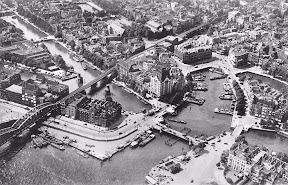
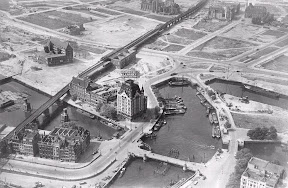
My street is about in the top left corner of the pictures... To the best of my knowledge, these pictures are the property of the educational organisation KMLA.
The picture below though is my own. It shows the lights produced by the hundreds of projectors that the city placed around the border of the destroyed area today. The Dutch call it the Vuurzeegrens (the border of the sea of fire). It speaks for itself, I guess.
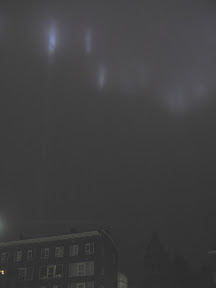
Eventually, you can find a lot more information there: Gemeentearchief.
Today was 14th May and a very special day in Rotterdam. It was Herdenkingdag, the commemoration of the day when, 67 years ago, the historical town center was totally wiped out by 95 Henkel 111 from the Luftwaffe. The old city (which was at that time looking very much like Den Haag) burned completely, leaving 73,000 homeless and 850 killed.
To give you an idea and commemorate this horrible day in my own way, I have uploaded two pictures which speak for themselves. They show the exact area where I know live, before and after the bombing.
My street is about in the top left corner of the pictures... To the best of my knowledge, these pictures are the property of the educational organisation KMLA.
The picture below though is my own. It shows the lights produced by the hundreds of projectors that the city placed around the border of the destroyed area today. The Dutch call it the Vuurzeegrens (the border of the sea of fire). It speaks for itself, I guess.
Eventually, you can find a lot more information there: Gemeentearchief.
11 May 2007
Mouvement Démocrate
Dear readers and especially dear brother,
I want to answer a comment you made to my previous post, about the lack of support for François Bayrou new political party, the MD (Mouvement Démocrate). I do not agree with you on the risk of Bayrou's voters afraid that he goes too much on the left side. I think that many voters interested in the new MD are actually fed up with the artificial opposition between right and left. Not that this opposition has no roots or ideological reasons (as you pointed out I learned at "Science Po" what it meant). But it is used by the two main parties to strangle and crush any alternative way, any attempt to think out of the frame. The MD is, I believe, one of these attempts. Don't take me wrong, I do not agree with everything they say. I don't look happily at Bayrou's face, dreaming of him as France and Europe's savior.
I know politics too much to ignore that politicians (as brilliant as they may be) are always disappointing and that as soon as they seize power, power corrupts them quickly. Sarkozy and Bayrou are no exceptions. I also dislike the not so secular ideas of both (in very different ways, obvously). Eventually, I also dislike in both the temptation they always had to maneuver with the party barons rather than to appeal to the citizens.
But I prefer in Bayrou the freshness of the approach, the sincere Europeanism and Humanism and most of all the anti-Jacobin stance. This man knows what to do with local powers, regional and communal collectivities and what the real place of the state as well of Europe should be. This guy believes in subsidiarity or at least he says he believes in it. About Europe, I believe a few images could be more eloquent than my prose:
I want to answer a comment you made to my previous post, about the lack of support for François Bayrou new political party, the MD (Mouvement Démocrate). I do not agree with you on the risk of Bayrou's voters afraid that he goes too much on the left side. I think that many voters interested in the new MD are actually fed up with the artificial opposition between right and left. Not that this opposition has no roots or ideological reasons (as you pointed out I learned at "Science Po" what it meant). But it is used by the two main parties to strangle and crush any alternative way, any attempt to think out of the frame. The MD is, I believe, one of these attempts. Don't take me wrong, I do not agree with everything they say. I don't look happily at Bayrou's face, dreaming of him as France and Europe's savior.
I know politics too much to ignore that politicians (as brilliant as they may be) are always disappointing and that as soon as they seize power, power corrupts them quickly. Sarkozy and Bayrou are no exceptions. I also dislike the not so secular ideas of both (in very different ways, obvously). Eventually, I also dislike in both the temptation they always had to maneuver with the party barons rather than to appeal to the citizens.
But I prefer in Bayrou the freshness of the approach, the sincere Europeanism and Humanism and most of all the anti-Jacobin stance. This man knows what to do with local powers, regional and communal collectivities and what the real place of the state as well of Europe should be. This guy believes in subsidiarity or at least he says he believes in it. About Europe, I believe a few images could be more eloquent than my prose:
08 May 2007
Results of the French Elections
Dear readers,
Now that the emotions of the first hours have passed, I'll have a comment on the results of the French elections. There was very little suspense of course, so I won't say that I was not expecting it. Nicolas Sarkozy, right wing (UMP) contender and the son of Hungarian immigrants in France, has won the Presidency. He will officially become French Vth Republic 6th President on 16th May. Legislative elections will follow where he will likely catch another absolute majority for his party, ensuring that all powers depends on him.
Wait, rewind... Not so sure after all. The Socialists, a bit stun by the defeat but encouraged by an historically high level of votes are going to put up a bitter fight. More importantly for me and for millions of voters (18% of them actually), there will be a third choice. Again, like for the first round of the Presidential elections, there will be more choice than between right wing conservatism and unchecked free market or left wing conservatism and all around state intervention. Ségolène Royale (the Socialist) just like Nicolas Sarkozy are trying to sell us the idea that the legislative is not a third round ("la belle" in French card games). But it actually is. There is eventually a chance for all people that are not happy with the choice they had in the second round to put enough Representative to the Parliament to make their voice heard.
The alternative choice to the UMP conservatists will of course be to give more legislative (and potentially Ministerial) power to the Socialists, to one of the extreme right or left parties (National Front, Workers Party, Revolutionary Communist League, Communist Party, etc.) to the Greens or of course to François Bayrou new MD party. MD stands for "Mouvement Démocratique" (French for democratic movement, obviously) and is a centrist party, fishing in the Christian democrat style as well as the socio-democrat ideas. The MD will replace the old UDF, a notability party whose politicians totally discredited themselves by betraying their leader to support the obvious winner Sarkozy.
Unfortunately, as a French citizen residing abroad, I won't have any voice in this third round. French abroad are not represented in the National Assembly and can't vote to elect its Representants (called "Députés" in French). There is no good reason for this, nor any explanation. It is just like that. It's likely to be because of the lack of funding of the French Foreign Ministry... And it is unlikely to change any time soon. Parties only interest themselves in French citizens abroad when it's Presidential election. Because they represent a large body of voters, they are interesting. But making them happy the rest of the time is not worth it. French people abroad have more open minds and broader views. They could bring challenges and innovation to France politics and of course our politicians don't want anything to trouble their good sleep and peace of mind... sorry, their hard work in service of the citizens. ;-)
Now that the emotions of the first hours have passed, I'll have a comment on the results of the French elections. There was very little suspense of course, so I won't say that I was not expecting it. Nicolas Sarkozy, right wing (UMP) contender and the son of Hungarian immigrants in France, has won the Presidency. He will officially become French Vth Republic 6th President on 16th May. Legislative elections will follow where he will likely catch another absolute majority for his party, ensuring that all powers depends on him.
Wait, rewind... Not so sure after all. The Socialists, a bit stun by the defeat but encouraged by an historically high level of votes are going to put up a bitter fight. More importantly for me and for millions of voters (18% of them actually), there will be a third choice. Again, like for the first round of the Presidential elections, there will be more choice than between right wing conservatism and unchecked free market or left wing conservatism and all around state intervention. Ségolène Royale (the Socialist) just like Nicolas Sarkozy are trying to sell us the idea that the legislative is not a third round ("la belle" in French card games). But it actually is. There is eventually a chance for all people that are not happy with the choice they had in the second round to put enough Representative to the Parliament to make their voice heard.
The alternative choice to the UMP conservatists will of course be to give more legislative (and potentially Ministerial) power to the Socialists, to one of the extreme right or left parties (National Front, Workers Party, Revolutionary Communist League, Communist Party, etc.) to the Greens or of course to François Bayrou new MD party. MD stands for "Mouvement Démocratique" (French for democratic movement, obviously) and is a centrist party, fishing in the Christian democrat style as well as the socio-democrat ideas. The MD will replace the old UDF, a notability party whose politicians totally discredited themselves by betraying their leader to support the obvious winner Sarkozy.
Unfortunately, as a French citizen residing abroad, I won't have any voice in this third round. French abroad are not represented in the National Assembly and can't vote to elect its Representants (called "Députés" in French). There is no good reason for this, nor any explanation. It is just like that. It's likely to be because of the lack of funding of the French Foreign Ministry... And it is unlikely to change any time soon. Parties only interest themselves in French citizens abroad when it's Presidential election. Because they represent a large body of voters, they are interesting. But making them happy the rest of the time is not worth it. French people abroad have more open minds and broader views. They could bring challenges and innovation to France politics and of course our politicians don't want anything to trouble their good sleep and peace of mind... sorry, their hard work in service of the citizens. ;-)
04 May 2007
03 May 2007
A Mini-treaty or a Mini-Europe?
Dear readers,
In this day of celebrating Free Press all over the World, I couldn't abstain from blogging. I was happily surprised today to read in the as usual excellent EU-Observer that Romano Prodi is now favoring an adoption of the rejected EU constitutional treaty by the countries which already ratified it. These 18 countries (which include Italy and Germany but not France nor the Netherlands) could then go on with the improved decision rules, while the others stay with the unpractical Nice treaty provisions.
I have to say that I am totally in favor of this. Some countries didn't join the Euro or the Schengen agreement, either because they were not ready for these improvements or because they had political reservations. Why not do the same for this new addendum to the European building? We (the French and the Dutch), together with the English, are obviously not ready to enjoy the improvements of the new rules. French and Dutch citizens seem to appreciate the opacity and lack of democracy of the current rules. Why should we stop other citizens, more interested in their rights and more advanced in their political culture, to go further than us along that road.
When our populations and politicians will be adult enough to understand this, then they will be able to join the rest of Europe. This, and maybe also the fear of being left behind with the English... ;-)
In this day of celebrating Free Press all over the World, I couldn't abstain from blogging. I was happily surprised today to read in the as usual excellent EU-Observer that Romano Prodi is now favoring an adoption of the rejected EU constitutional treaty by the countries which already ratified it. These 18 countries (which include Italy and Germany but not France nor the Netherlands) could then go on with the improved decision rules, while the others stay with the unpractical Nice treaty provisions.
I have to say that I am totally in favor of this. Some countries didn't join the Euro or the Schengen agreement, either because they were not ready for these improvements or because they had political reservations. Why not do the same for this new addendum to the European building? We (the French and the Dutch), together with the English, are obviously not ready to enjoy the improvements of the new rules. French and Dutch citizens seem to appreciate the opacity and lack of democracy of the current rules. Why should we stop other citizens, more interested in their rights and more advanced in their political culture, to go further than us along that road.
When our populations and politicians will be adult enough to understand this, then they will be able to join the rest of Europe. This, and maybe also the fear of being left behind with the English... ;-)
01 May 2007
Koninginedag
Dear readers,
Today was Queen's Day, or in the Dutch lingo "Koninginedag" (try to say that fast and don't forget that the g is pronounced like a Spanish j, except after another consonant...). Lots of people dressed up in orange in the streets, and with the most outrageous outfit. It was fun though. I even went to help M-So to sell old cloths in the street. We had quite good fun, a lot of tanning, but didn't sell much. I'll post some pictures about this event tomorrow. Just to give you who read me from around the world an idea of what it's like in this low land.
To stay on the bright side, I might have a new job very soon. Contract isn't signed yet, but it looks good so far.
And a last treat, for you French readers, I added a link to my brother's blog. Enjoy!
Today was Queen's Day, or in the Dutch lingo "Koninginedag" (try to say that fast and don't forget that the g is pronounced like a Spanish j, except after another consonant...). Lots of people dressed up in orange in the streets, and with the most outrageous outfit. It was fun though. I even went to help M-So to sell old cloths in the street. We had quite good fun, a lot of tanning, but didn't sell much. I'll post some pictures about this event tomorrow. Just to give you who read me from around the world an idea of what it's like in this low land.
To stay on the bright side, I might have a new job very soon. Contract isn't signed yet, but it looks good so far.
And a last treat, for you French readers, I added a link to my brother's blog. Enjoy!
26 April 2007
Polling station queue


23 April 2007
Disappointment
Dear readers,
It is little to say that I am disappointed this morning. The French election first round results are there and I am only seeing an all too usual pair in the qualified for the second round: right against left, pro-business conservatives against pro-state conservatives... Nothing really palatable at first glance. This said, this election was already a good thing for some reasons.
First, French people showed eventually that they could vote "en masse" if the proposed debate was up to stir their interest. The quality of this debate and of the candidates was, I believe, a reason for this stunning 84.7% participation. Something unseen, practically, since the founding of the Vth Republic in 1958. For this I am proud of my fellow citizens.
I am a lot less proud of my country's journalists, though. They have shown partiality, narrow mindedness and pettiness. Instead of seeing what was new and interesting in this debate (like millions of French voters rightly did), that is the emergence of a third way in the political debate, they desperately clinched to the old divisions and cliché. The first of them, the Chief Redactor of center left journal Le Monde, Jean-Marie Colombani, couldn't help but fall in that trap. Was it partiality? Was it simply lack of imagination? I would say more probably intellectual laziness. I live the second editorial in three days he wrote for everyone to see. It is not a particularly fair article, neither very responsible. At least the analysis is, I believe, correct.
The center party UDF is now placed in the delicate and more uncomfortable position than may appear at first sight of having to chose who to support. Will François Bayrou stick to its old center right roots and support UMP's Nicolas Sarkozy? I doubt it and I hope not. Will he sell very hard his support to Ségolène Royale. I hope he dares enough for this. I would probably vote for her then, though reluctantly. Actually, his credibility as a politician will hang upon the concessions he will manage to get from his rivals. Only if he seems to get more than what he gives will he be seen as strong and a potentially future President (for 2012). The only other option, and that one could well be preferable for him (as seen by Le Monde too) would be to give a consign of voting blank. I would probably follow that if Sarkozy and Royale refuse to negotiate with him a fair and balanced coalition.
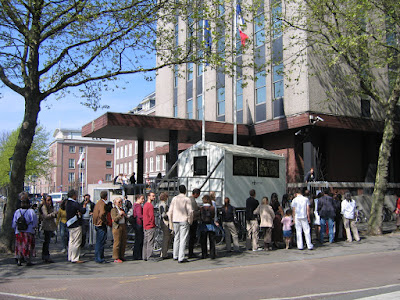
On a sadder note, I was not allowed to vote for this first round. My inscription on the electoral list had been canceled, due to the end of validity of my registration at the French Consulate. Apparently, I was never made aware of this because the French Ministry of Foreign Affairs (which centralizes all these mailings, in a typical inefficient French way) didn't have the budget to send a reminding letter. This prevented hundreds of French citizens to vote, depriving them (and me) of their most basic civic rights, one of the only links still binding them to the nation. This was a frustrating experience (having to queue for an hour to discover that), which added to my disappointment at the absence of my favorite candidate in the second round. Round where I will eventually be allowed to vote... but too late to make a difference. Bureaucratic bastards!
It is little to say that I am disappointed this morning. The French election first round results are there and I am only seeing an all too usual pair in the qualified for the second round: right against left, pro-business conservatives against pro-state conservatives... Nothing really palatable at first glance. This said, this election was already a good thing for some reasons.
First, French people showed eventually that they could vote "en masse" if the proposed debate was up to stir their interest. The quality of this debate and of the candidates was, I believe, a reason for this stunning 84.7% participation. Something unseen, practically, since the founding of the Vth Republic in 1958. For this I am proud of my fellow citizens.
I am a lot less proud of my country's journalists, though. They have shown partiality, narrow mindedness and pettiness. Instead of seeing what was new and interesting in this debate (like millions of French voters rightly did), that is the emergence of a third way in the political debate, they desperately clinched to the old divisions and cliché. The first of them, the Chief Redactor of center left journal Le Monde, Jean-Marie Colombani, couldn't help but fall in that trap. Was it partiality? Was it simply lack of imagination? I would say more probably intellectual laziness. I live the second editorial in three days he wrote for everyone to see. It is not a particularly fair article, neither very responsible. At least the analysis is, I believe, correct.
The center party UDF is now placed in the delicate and more uncomfortable position than may appear at first sight of having to chose who to support. Will François Bayrou stick to its old center right roots and support UMP's Nicolas Sarkozy? I doubt it and I hope not. Will he sell very hard his support to Ségolène Royale. I hope he dares enough for this. I would probably vote for her then, though reluctantly. Actually, his credibility as a politician will hang upon the concessions he will manage to get from his rivals. Only if he seems to get more than what he gives will he be seen as strong and a potentially future President (for 2012). The only other option, and that one could well be preferable for him (as seen by Le Monde too) would be to give a consign of voting blank. I would probably follow that if Sarkozy and Royale refuse to negotiate with him a fair and balanced coalition.
On a sadder note, I was not allowed to vote for this first round. My inscription on the electoral list had been canceled, due to the end of validity of my registration at the French Consulate. Apparently, I was never made aware of this because the French Ministry of Foreign Affairs (which centralizes all these mailings, in a typical inefficient French way) didn't have the budget to send a reminding letter. This prevented hundreds of French citizens to vote, depriving them (and me) of their most basic civic rights, one of the only links still binding them to the nation. This was a frustrating experience (having to queue for an hour to discover that), which added to my disappointment at the absence of my favorite candidate in the second round. Round where I will eventually be allowed to vote... but too late to make a difference. Bureaucratic bastards!
17 April 2007
Bowling for Virginia Tech
Dear readers,
Sorry for the title, I know it is crap but I didn't find anything better. So yes, it is a bit of an obliged topic...
Apart from the obvious condolences to the victims families and friends, I believe that the USA and Virginia in particular deserve a bit more. I was thinking about letting it go, but then I saw this guy talking about it on CNN and making all kinds of reasoning and comments (out of his arse for sure...) to explain it and to try to blame it on anything except guns. It was so pitiful and, I dare say, painful to see a human being going so low in the abjection that I felt compelled to write this.
So the poor guy began blaming the society and the American decadence and of course, guess what: video games! Yes, you have heard it: student Cho didn't murder in cold blood 32 people, wounding many others and committing suicide afterwards, with a 9mm and a 22LR automatic guns. No, he did it with video games. He slaughtered all his co-students with a Playstation! Sometimes NRA people are just ridiculous, but I believe this one was frankly bordering the evil.
Someone should have reminded this moron that this kind of events rarely happen (if not never) in Europe. And why? Well, simple enough: you can't get a gun like that. For the first time I had the irony to to find myself in total agreement with Australian Prime Minister John Howard who said that he was sorry for what happened but that it was certainly at least partly due to American gun culture and the absence of gun control laws in the USA and especially in Virginia.
Anything else is nonsense. Statistics are there to prove it: no gun control means multiple murders, gun control means none (or a lot less). Everything else is pure lobbying...
Sorry for the title, I know it is crap but I didn't find anything better. So yes, it is a bit of an obliged topic...
Apart from the obvious condolences to the victims families and friends, I believe that the USA and Virginia in particular deserve a bit more. I was thinking about letting it go, but then I saw this guy talking about it on CNN and making all kinds of reasoning and comments (out of his arse for sure...) to explain it and to try to blame it on anything except guns. It was so pitiful and, I dare say, painful to see a human being going so low in the abjection that I felt compelled to write this.
So the poor guy began blaming the society and the American decadence and of course, guess what: video games! Yes, you have heard it: student Cho didn't murder in cold blood 32 people, wounding many others and committing suicide afterwards, with a 9mm and a 22LR automatic guns. No, he did it with video games. He slaughtered all his co-students with a Playstation! Sometimes NRA people are just ridiculous, but I believe this one was frankly bordering the evil.
Someone should have reminded this moron that this kind of events rarely happen (if not never) in Europe. And why? Well, simple enough: you can't get a gun like that. For the first time I had the irony to to find myself in total agreement with Australian Prime Minister John Howard who said that he was sorry for what happened but that it was certainly at least partly due to American gun culture and the absence of gun control laws in the USA and especially in Virginia.
Anything else is nonsense. Statistics are there to prove it: no gun control means multiple murders, gun control means none (or a lot less). Everything else is pure lobbying...
12 April 2007
Humanism
Dear readers,
As you can see in my book list, I have recently read the "Erasmus" of Stefan Zweig, the biography of the arguably most famous Rotterdamer. Thanks to M-So for lending me the book (and yes, I'll give it back to you asap if my cat does not eat it before).
It is a very interesting book, I'd say and particularly fitting our troubling times. It has also the enormous advantage of being short and extremely well written. Stefan Zweig was a highly cultivated person and a incredible writer, if sometimes a bit excessive in expressing his feelings, in my humble opinion. But of course, it was the 30's, not a time known for its lack of excesses.
This said, I'd like to point out the extraordinary similarities between Erasmus time and ours (not to mention Stefan Zweig time). And by this to demonstrate the importance of what we can still learn from the greatest and the first of the Humanists. Erasmus of Rotterdam was what was called at that time a "Renaissance man" (in French "un honnête homme"). There is obviously no way anymore to have a holistic knowledge of all sciences and arts like him. But his analysis, his way can still be of great use. Indeed, isn't it obvious that our XXIst century is beginning just like the Renaissance, in some way? The massive Huntingtonian opposition between the Western world and the Muslim world today is extremely similar to the Religious Wars of the time of Martin Luther and Leon X. Without saying who is right and who is not (and frankly it does not matter), there are obvious parallelism between the extreme violence of an Al Qaeda, for instance and the cruelty showed by the Reformed against the peasants of Münzer, for instance, or during the Rome plundering. This last event had exactly the same effect than 9/11 on the Papacy. Leon X authorized the monk Cafara (the later Pope Paul IV) to create the Inquisition.
We know what followed and which permanent division of the Christian World and of Europe in general was born through these events. Nationalism was a direct product of the Religious Wars in Europe and I dare say that there is a nearly uninterrupted chain of events (the French Revolution apart) which leads from these Wars to the two World Wars. And isn't it also true that we can compare the reaction of the Republican US administration to the one of the Catholic lands at that time. The justification of torture to "help terrorists to confess"? The use of extra judicial jails and ad hoc procedures? The use of preventive war, in the name of God or Democracy? Of course, not everything is the same. Each epoch has its own problems and singularities. But it should be obvious that we need a new Erasmus.
Someone wise enough to be respected by everyone. Someone, I would say, even better than Erasmus. Because, Zweig points it very clearly in this biography, Erasmus had a terribly weak point. He was not brave. He was physically a coward (according to his own words). He was terrified by Luther and just as terrified by the reaction of the Catholic authorities. For this reason, he twice refused the invitation to attend the Diete (at Worms and later Augsburg) where probably only him could have made a difference and avoid the definitive condemnations issued at these events. Preaching peace and writing about Europeanism is a great thing. It is worthy of our admiration, and I will always follow Erasmus ideas... Because, as he said, "heel de aarde is je Vaderland". But acting is just as important, be it only by the strength of words. Because failing to act right can be just as irresponsible than acting wrong.
As you can see in my book list, I have recently read the "Erasmus" of Stefan Zweig, the biography of the arguably most famous Rotterdamer. Thanks to M-So for lending me the book (and yes, I'll give it back to you asap if my cat does not eat it before).
It is a very interesting book, I'd say and particularly fitting our troubling times. It has also the enormous advantage of being short and extremely well written. Stefan Zweig was a highly cultivated person and a incredible writer, if sometimes a bit excessive in expressing his feelings, in my humble opinion. But of course, it was the 30's, not a time known for its lack of excesses.
This said, I'd like to point out the extraordinary similarities between Erasmus time and ours (not to mention Stefan Zweig time). And by this to demonstrate the importance of what we can still learn from the greatest and the first of the Humanists. Erasmus of Rotterdam was what was called at that time a "Renaissance man" (in French "un honnête homme"). There is obviously no way anymore to have a holistic knowledge of all sciences and arts like him. But his analysis, his way can still be of great use. Indeed, isn't it obvious that our XXIst century is beginning just like the Renaissance, in some way? The massive Huntingtonian opposition between the Western world and the Muslim world today is extremely similar to the Religious Wars of the time of Martin Luther and Leon X. Without saying who is right and who is not (and frankly it does not matter), there are obvious parallelism between the extreme violence of an Al Qaeda, for instance and the cruelty showed by the Reformed against the peasants of Münzer, for instance, or during the Rome plundering. This last event had exactly the same effect than 9/11 on the Papacy. Leon X authorized the monk Cafara (the later Pope Paul IV) to create the Inquisition.
We know what followed and which permanent division of the Christian World and of Europe in general was born through these events. Nationalism was a direct product of the Religious Wars in Europe and I dare say that there is a nearly uninterrupted chain of events (the French Revolution apart) which leads from these Wars to the two World Wars. And isn't it also true that we can compare the reaction of the Republican US administration to the one of the Catholic lands at that time. The justification of torture to "help terrorists to confess"? The use of extra judicial jails and ad hoc procedures? The use of preventive war, in the name of God or Democracy? Of course, not everything is the same. Each epoch has its own problems and singularities. But it should be obvious that we need a new Erasmus.
Someone wise enough to be respected by everyone. Someone, I would say, even better than Erasmus. Because, Zweig points it very clearly in this biography, Erasmus had a terribly weak point. He was not brave. He was physically a coward (according to his own words). He was terrified by Luther and just as terrified by the reaction of the Catholic authorities. For this reason, he twice refused the invitation to attend the Diete (at Worms and later Augsburg) where probably only him could have made a difference and avoid the definitive condemnations issued at these events. Preaching peace and writing about Europeanism is a great thing. It is worthy of our admiration, and I will always follow Erasmus ideas... Because, as he said, "heel de aarde is je Vaderland". But acting is just as important, be it only by the strength of words. Because failing to act right can be just as irresponsible than acting wrong.
08 April 2007
Developments in the Port of Marseille
Dear readers,
Despite the fact that I am no more working for a Port company, I continue to stay tuned to what happens in the global port community (and you can follow this too through the news links on the right hand side of this blog). Unfortunately, the big news in the latest days, apart from the Russian wishes to invest in Indian ports and the swallowing of Comanav and Cheng Lie by CMA CGM, was the end of the very long strike in the Port of Marseille. An other one you might say, and you would be right. So let's have a look at what happened and the economic and social consequences.
The strike began more than two weeks ago, by a blockade of the oil terminals (Marseille first and foremost activity) by the CGT union workers of the Port. The alleged reason was that future gas terminals belonging and operated by Gaz de France (and not by the Port of Marseille, contrarily to the existing facilities) would be served by Gaz de France (GDF) own personnels. Gas terminals have obviously massive safety issues and are probably the most dangerous ones in case of an accident, especially for neighboring communities. Port Autonome employees have not the required training, don't answer to the terminal operator and are not under its responsibility either from a legal point of view. But European regulations on safety make very clear that the operator is still liable if an accident occurs due to a contractor's employee (which would be the exact situation if Gaz de France used Port Autonome staff). Very understandably so, GDF refused to use Port Autonome employees. The strike began, the conflict blocking not only the oil terminals but also soon the roro and container terminals.
The loss for the Port of Marseille, already a very marginal port in the Mediterranean game, became very quickly enormous, reaching dozens of millions of Euros according to Mer & Marine news website. The government, main shareholder of Gaz de France, decided that the damage was too big and asked GDF to accept the union claims. In the end, to ensure the employment of 5 totally worthless unionized employees, this blackmailing game has hurt pretty bad the local economy, the already abysmal port reputation and more largely the credibility of French Ports. The private interests of a small mafia has (again) been preferred to the greater interest of millions of people, employees, families and companies.
Let's make no mistake here. I don't deny the obvious importance and necessity of unions to defend the interests of employees. These interests are all too often forgotten by soulless companies and exploiting managers. But there are also limits to social conflicts. When unions are fighting for salaries, economic improvements, work conditions and safety, I am all for it. But when unions, and it was obviously the case here, are only defending a monopoly, working against safety, against the improvement of economic conditions and of employment, I would say the government should on the contrary show some balls and do its job. The strike blocked terminals of other operators which had nothing to do with this. The police should have been sent to unlock the situation, the tribunal should have condemned the strike as obviously illegal and the union people on the blockades should have been fined and sent to jail. It is NOT an attempt on the striking rights of employees to break a strike when it is clearly breaking the laws.
In the end, Marseille has and will again lose traffic to the ports of Genoa and Barcelona or Valencia. The Port will again see its activity limited to its direct hinterland, which is geographically limited to the area south of Lyon. Employment in the Port will stagnate and economic growth which could be buoyant like in all other Mediterranean ports (with growth rates up to 9 or 10%) will remain limited to a couple of percentage points. All of this for five union people...
Despite the fact that I am no more working for a Port company, I continue to stay tuned to what happens in the global port community (and you can follow this too through the news links on the right hand side of this blog). Unfortunately, the big news in the latest days, apart from the Russian wishes to invest in Indian ports and the swallowing of Comanav and Cheng Lie by CMA CGM, was the end of the very long strike in the Port of Marseille. An other one you might say, and you would be right. So let's have a look at what happened and the economic and social consequences.
The strike began more than two weeks ago, by a blockade of the oil terminals (Marseille first and foremost activity) by the CGT union workers of the Port. The alleged reason was that future gas terminals belonging and operated by Gaz de France (and not by the Port of Marseille, contrarily to the existing facilities) would be served by Gaz de France (GDF) own personnels. Gas terminals have obviously massive safety issues and are probably the most dangerous ones in case of an accident, especially for neighboring communities. Port Autonome employees have not the required training, don't answer to the terminal operator and are not under its responsibility either from a legal point of view. But European regulations on safety make very clear that the operator is still liable if an accident occurs due to a contractor's employee (which would be the exact situation if Gaz de France used Port Autonome staff). Very understandably so, GDF refused to use Port Autonome employees. The strike began, the conflict blocking not only the oil terminals but also soon the roro and container terminals.
The loss for the Port of Marseille, already a very marginal port in the Mediterranean game, became very quickly enormous, reaching dozens of millions of Euros according to Mer & Marine news website. The government, main shareholder of Gaz de France, decided that the damage was too big and asked GDF to accept the union claims. In the end, to ensure the employment of 5 totally worthless unionized employees, this blackmailing game has hurt pretty bad the local economy, the already abysmal port reputation and more largely the credibility of French Ports. The private interests of a small mafia has (again) been preferred to the greater interest of millions of people, employees, families and companies.
Let's make no mistake here. I don't deny the obvious importance and necessity of unions to defend the interests of employees. These interests are all too often forgotten by soulless companies and exploiting managers. But there are also limits to social conflicts. When unions are fighting for salaries, economic improvements, work conditions and safety, I am all for it. But when unions, and it was obviously the case here, are only defending a monopoly, working against safety, against the improvement of economic conditions and of employment, I would say the government should on the contrary show some balls and do its job. The strike blocked terminals of other operators which had nothing to do with this. The police should have been sent to unlock the situation, the tribunal should have condemned the strike as obviously illegal and the union people on the blockades should have been fined and sent to jail. It is NOT an attempt on the striking rights of employees to break a strike when it is clearly breaking the laws.
In the end, Marseille has and will again lose traffic to the ports of Genoa and Barcelona or Valencia. The Port will again see its activity limited to its direct hinterland, which is geographically limited to the area south of Lyon. Employment in the Port will stagnate and economic growth which could be buoyant like in all other Mediterranean ports (with growth rates up to 9 or 10%) will remain limited to a couple of percentage points. All of this for five union people...
06 April 2007
It's Spring
 |
| From Marelles-blog |
Dear readers,
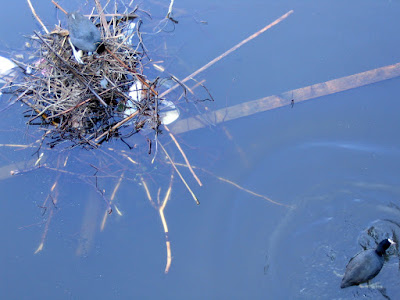
It is spring and the birds are building their nests. Unfortunately, for these water hens it means using what they can find in their direct environment. In the Leuwehaven area, in Rotterdam, it is essentially broken branches, waste and dirt from the surrounding local shops. I don't know what kind of life it will be for the chickens (you can see the eggs under the mother's belly), but it is still a bit sad to realize they will be born amongst oily jerrycans and pieces of pipes rather than straw and feathers.
Pictures from Picasa still don't work, apparently. I'll update this post later to show you the actual pic.
Update: As promised, here is the actual picture. Still no news from Picasa, Google or Blogger... :-(
30 March 2007
EU Observer - Joschka Fischer speech
Dear readers,
Here is another excellent comment from the EU Observer about the latest speech from German ex-Foreign Minister, Joschka Fischer. Fischer will certainly be sorely missed as a Foreign Minister, as his ideas, strong will and imagination were behind some of the best pages of European recent History. Unfortunately, this time, the new Princeton Professor is more playing the role of Cassandra. And rightly so, I could add.
While I would advise you to read the full article, there is I think one point which is absolutely central to Fischer's "prediction" and that I think any European citizen should know about. He says that if the EU has not at least partly settled its institutional problem by the end of 2009, it will most probably be too late. At that time, the quick strengthening of the other major powers (China, India and in a lesser way the USA and Russia) will have render us irrelevant. Europea is already a very secondary player in world politics, not because it is less important, sizable or economically powerful, but simply because it will have become a playground for the other powers. We all know what this means. Europe was forced to be a playground after Second World War and during the Cold War, because it had no political unity and no own military power. After 1989, we got a window of opportunity to create this political unity, which we achieved in some ways by the process between the fall of the Berlin Wall and the latest wave of EU expansion in 2006. But this achievement has been halted, incomplete and dangerously off balance, without an institutional cement which would guarantee its sustainability and practical daily functioning.
Even worse, its military and foreign policy power and influence are, to say the least, ridiculous. This has simply never been considered as a priority by European nation states who wrongly believe that they are better protected on their own. This vision has shown its total obsolescence in the latest years, though no one seems to care or even think it is important. Europe faces major challenges of terrorism, power bullies, capacity projection, environmental issues and economic deficiencies, but it has no way of presenting a coordinated answer to these. One of the main reasons is of course the attitude of some specific member states which are already playing against their fellow European states by favoring one of the super powers, the power bullies as I named them, above the common European interest (the United Kingdom obviously). Others are doing so by simple lack of political vision or mere ignorance (Poland, France).
We have a last window of opportunity. We can vote a new constitution (or whatever you call it), with or without the splinter states who don't want to count in the future world game. We can, if we are fast and clever, create a better Europe for ourselves and for our children. But if we wait too much, if we are not ambitious enough, we will become something like the ASEAN or Latin America: a playground for the USA, China and Russia, where it won't be our interest that will be debated and strengthened but the ones of the American companies, the Chinese corrupt elite and the Russian mafia. If this is what we want, then ok, let's change nothing and enjoy our petty divisions and our exploitation. Who cares, we won't count anymore. We will vote for leaders (if we are still allowed too) but it won't make any difference because these leaders won't actually take the decisions which will influence our lives.
Here is another excellent comment from the EU Observer about the latest speech from German ex-Foreign Minister, Joschka Fischer. Fischer will certainly be sorely missed as a Foreign Minister, as his ideas, strong will and imagination were behind some of the best pages of European recent History. Unfortunately, this time, the new Princeton Professor is more playing the role of Cassandra. And rightly so, I could add.
While I would advise you to read the full article, there is I think one point which is absolutely central to Fischer's "prediction" and that I think any European citizen should know about. He says that if the EU has not at least partly settled its institutional problem by the end of 2009, it will most probably be too late. At that time, the quick strengthening of the other major powers (China, India and in a lesser way the USA and Russia) will have render us irrelevant. Europea is already a very secondary player in world politics, not because it is less important, sizable or economically powerful, but simply because it will have become a playground for the other powers. We all know what this means. Europe was forced to be a playground after Second World War and during the Cold War, because it had no political unity and no own military power. After 1989, we got a window of opportunity to create this political unity, which we achieved in some ways by the process between the fall of the Berlin Wall and the latest wave of EU expansion in 2006. But this achievement has been halted, incomplete and dangerously off balance, without an institutional cement which would guarantee its sustainability and practical daily functioning.
Even worse, its military and foreign policy power and influence are, to say the least, ridiculous. This has simply never been considered as a priority by European nation states who wrongly believe that they are better protected on their own. This vision has shown its total obsolescence in the latest years, though no one seems to care or even think it is important. Europe faces major challenges of terrorism, power bullies, capacity projection, environmental issues and economic deficiencies, but it has no way of presenting a coordinated answer to these. One of the main reasons is of course the attitude of some specific member states which are already playing against their fellow European states by favoring one of the super powers, the power bullies as I named them, above the common European interest (the United Kingdom obviously). Others are doing so by simple lack of political vision or mere ignorance (Poland, France).
We have a last window of opportunity. We can vote a new constitution (or whatever you call it), with or without the splinter states who don't want to count in the future world game. We can, if we are fast and clever, create a better Europe for ourselves and for our children. But if we wait too much, if we are not ambitious enough, we will become something like the ASEAN or Latin America: a playground for the USA, China and Russia, where it won't be our interest that will be debated and strengthened but the ones of the American companies, the Chinese corrupt elite and the Russian mafia. If this is what we want, then ok, let's change nothing and enjoy our petty divisions and our exploitation. Who cares, we won't count anymore. We will vote for leaders (if we are still allowed too) but it won't make any difference because these leaders won't actually take the decisions which will influence our lives.
29 March 2007
Rotterdam Blaak

Dear readers,
I am just trying to upload photos to the blog. This function has currently a bug, but I let it in this state to allow Google engineers to see what is wrong and repair it.
Thank you for your patience.
Update: I had enough of this so I edited the picture in My Album in Picasa, and this message accordingly. Google people believe it is a connexion issue, but I am afraid this looks more like a browser incompatibility. Because everything works perfectly from my laptop with IE7.
26 March 2007
EXIT

Dear readers,
Despite the fact that I am now full time seraching for a new position, I try not close myself completely, would it be only to make sure that I continue to cultivate my network. So that's how I was invited yesterday to a DJ's show at the old Rottterdam's club the Exit. The Exit is an old club recently renovated. I used to go there before they changed the whole place. It was always a cool place to dance on Afro-cuban or jazzy music. There were always good dancer, making quite of a show. The only problem was that it was also one of the only place where people were allowed to smoke pot while dancing. Which means that it used to be pretty smoky.
Now the place is much more trendy, though the crowd has kept some of the typical Rotterdam's underground scene. The party was called Semtexx. I hope these guys don't really know what Semtex is, because I think it is a crappy name for a party. But anyway... DJs were pretty good, as far as I can tell. Of course, I am not very knowledgeable in terms of techno and house music. I could tell that it was good though, because of the technique. What you have to know is that many club DJs in Holland are quite bad. They simply ignore the need of a smooth transition between two songs or themes. Nothing of this yesterday. I saw three of them in a three hour succession and they definitely knew their job. As for the music itself, it was ok, even for me. That says it all... :-)
23 March 2007
How has the EU improved our lives?
Dear readers,
I take the opportunity of the 50th Anniversary of the European Union and of this excellent article in the EU Observer by BBC's correspondent Mathew Charles to try and show again why the EU integration is such a good thing for us citizens. This journalist compares the Eurovision song contest and the Rome Treaty (born only at one year of interval and for "similar reasons"). He can't fail to notice that the first one has been more successful than the second in terms of popularity.
And though, I can't quite accept the fact that many Europeans feel that the Eurovision has actually brought up more good to them than the European Union. Mathew Charles goes on to show that it is because the EU and the European Parliament are very bad communicators and he is obviously right. He is also right when he says that the EU has a bad image because it lets member States (and I would add the sewer press) make its communication and distort its message. I would go a bit further then, and say that it is also because many European citizens don't even try to understand what is going on. Not only for the EU, to be honest. I have noticed, even amongst relatively educated citizens, an lazy attitude towards information.Most people accept flatly what comes out of their favorite newspaper (or worse, from TV) and just swallows it without any double checking, any critical mindset or even any common sense.
OK, I know that it is not always the case, and I have had some happy surprises... But just to bring my stone to the building, I would like to list here some of the great improvements brought by the European Union (on top of the obvious 50 years of peace we had amongst its members, a duration unheard of in human kind History).
- The Water framework (still unrespected by many member states, including France) allows us, in theory, to have a constant access to quality unpolluted water, protects river and coastal fishs and plants and our environment.
- The fight against air pollution goes into the same vein. Without the EU, there wouldn't have been a Kyoto agreement, neither the tremendous improvement in our air quality we enjoyed.
- Safety regulations. Thanks to the EU, a high level of safety regulations for thousands of technical items, objects, toys or machines are protecting our lives and the one of our children, whatever country these goods are coming from.
- The freedom of travel and of circulation of goods has made our lives easier, has helped consistently contain the inflation to the lowest levels ever seen in Europe and has given us the opportunity to relatively cheap holidays in wonderful places, meeting wonderful people. OK. This one is not true for the UK and Ireland, but hey, nobody is perfect and we will have to deal with the Britons all our lives I guess :-(
- the European funding programs have helped hundreds of thousands of students from all over Europe to learn other languages, techniques and cultures. They have also helped thousands of unemployed people to get a professional training to get jobs, hundreds of thousands of scientists to make science go further, improve technologies and ultimately our lives. They also helped producing movies, shows, concerts, and all kind of artistic events and products. Eventually, they have tremendously improved national and transnational infrastructures, roads, railways, bridges, ports, hospitals, and many other things that we take for granted.
I could go on and on like this for pages, but the fact is, the EU has tremendously improved our lives and can continue doing so. But for this, it needs more support from its citizens, so a better communication indeed, and more support from its member states (which means that we must vote for honest people rather than the usual liars that vote for one thing in Brussels, then come back and spit on the EU if it doesn't work or boast for themselves if it did).
I take the opportunity of the 50th Anniversary of the European Union and of this excellent article in the EU Observer by BBC's correspondent Mathew Charles to try and show again why the EU integration is such a good thing for us citizens. This journalist compares the Eurovision song contest and the Rome Treaty (born only at one year of interval and for "similar reasons"). He can't fail to notice that the first one has been more successful than the second in terms of popularity.
And though, I can't quite accept the fact that many Europeans feel that the Eurovision has actually brought up more good to them than the European Union. Mathew Charles goes on to show that it is because the EU and the European Parliament are very bad communicators and he is obviously right. He is also right when he says that the EU has a bad image because it lets member States (and I would add the sewer press) make its communication and distort its message. I would go a bit further then, and say that it is also because many European citizens don't even try to understand what is going on. Not only for the EU, to be honest. I have noticed, even amongst relatively educated citizens, an lazy attitude towards information.Most people accept flatly what comes out of their favorite newspaper (or worse, from TV) and just swallows it without any double checking, any critical mindset or even any common sense.
OK, I know that it is not always the case, and I have had some happy surprises... But just to bring my stone to the building, I would like to list here some of the great improvements brought by the European Union (on top of the obvious 50 years of peace we had amongst its members, a duration unheard of in human kind History).
- The Water framework (still unrespected by many member states, including France) allows us, in theory, to have a constant access to quality unpolluted water, protects river and coastal fishs and plants and our environment.
- The fight against air pollution goes into the same vein. Without the EU, there wouldn't have been a Kyoto agreement, neither the tremendous improvement in our air quality we enjoyed.
- Safety regulations. Thanks to the EU, a high level of safety regulations for thousands of technical items, objects, toys or machines are protecting our lives and the one of our children, whatever country these goods are coming from.
- The freedom of travel and of circulation of goods has made our lives easier, has helped consistently contain the inflation to the lowest levels ever seen in Europe and has given us the opportunity to relatively cheap holidays in wonderful places, meeting wonderful people. OK. This one is not true for the UK and Ireland, but hey, nobody is perfect and we will have to deal with the Britons all our lives I guess :-(
- the European funding programs have helped hundreds of thousands of students from all over Europe to learn other languages, techniques and cultures. They have also helped thousands of unemployed people to get a professional training to get jobs, hundreds of thousands of scientists to make science go further, improve technologies and ultimately our lives. They also helped producing movies, shows, concerts, and all kind of artistic events and products. Eventually, they have tremendously improved national and transnational infrastructures, roads, railways, bridges, ports, hospitals, and many other things that we take for granted.
I could go on and on like this for pages, but the fact is, the EU has tremendously improved our lives and can continue doing so. But for this, it needs more support from its citizens, so a better communication indeed, and more support from its member states (which means that we must vote for honest people rather than the usual liars that vote for one thing in Brussels, then come back and spit on the EU if it doesn't work or boast for themselves if it did).
21 March 2007
Delfshaven

 Dear readers,
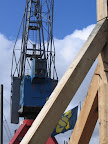
When I came out of my intake interview, I realized the CWI building (in the Delfshaven area) is not a far walk from the Lloyd's kwartier and its old shipyard. So I decided to take advantage of the beautiful (if freezing) weather and go take some nice pictures of the port of Rotterdam. Here are a couple of my shots. The place is on the North bank of the Maas river and there are a couple of new buildings with stunning modern architecture. There is also a shipyard where people are working on rebuilding an old Dutch wooden vessel, the Delft, and a small related museum. Enjoy...
Unemployment benefits (follow up)
Dear readers,
As much as I was appalled by the process of registering for my unemployment benefit, I was also quite happily surprised with the intake meeting today. First, the CWI building was not too far and in a decent building. Second, the waiting time was extremely reduced (a couple of minutes). Third, the intake interview itself was very fast and easy. The two or three persons I had to interact with were friendly, smiling, service minded and supportive. Fourth, the part of registering my declaration and filing for the benefits was done in the same office and practically at the same time. Last but not least, the explanations were clear and all my questions were quickly answered.
If I compare this with my experience of the French ASSEDIC and ANPE, it is like comparing day and night. First, at that time (I am speaking more than 7 years ago), there was no way you could fill in the forms on the Internet. Apart from this, the major hurdle with the French system is that you have two different bureaucracies to register as a job seeker and to file for the benefits. Which means massive queues to get your forms, fill them in, etc.
If anyone had told me that I would one day praise the Dutch bureaucracy, I wouldn't have believed it. But it is so... Of course, the fact that job seekers are nearly three times more numerous in France, compared with the active population, probably doesn't help. I can imagine that it is more difficult to handle more than two millions unemployed persons than a couple of hundreds of thousands.
As much as I was appalled by the process of registering for my unemployment benefit, I was also quite happily surprised with the intake meeting today. First, the CWI building was not too far and in a decent building. Second, the waiting time was extremely reduced (a couple of minutes). Third, the intake interview itself was very fast and easy. The two or three persons I had to interact with were friendly, smiling, service minded and supportive. Fourth, the part of registering my declaration and filing for the benefits was done in the same office and practically at the same time. Last but not least, the explanations were clear and all my questions were quickly answered.
If I compare this with my experience of the French ASSEDIC and ANPE, it is like comparing day and night. First, at that time (I am speaking more than 7 years ago), there was no way you could fill in the forms on the Internet. Apart from this, the major hurdle with the French system is that you have two different bureaucracies to register as a job seeker and to file for the benefits. Which means massive queues to get your forms, fill them in, etc.
If anyone had told me that I would one day praise the Dutch bureaucracy, I wouldn't have believed it. But it is so... Of course, the fact that job seekers are nearly three times more numerous in France, compared with the active population, probably doesn't help. I can imagine that it is more difficult to handle more than two millions unemployed persons than a couple of hundreds of thousands.
20 March 2007
McJobs
Dear readers,
I was puzzled today by a CNN program about jobs. Mc Donalds, the famous fast food chain, is trying to change the perception of job opportunities within the company. The term McJob has indeed been used worldwide to mock the products of the company and describe an unattractive, boring and poorly paid job. A job that we would call in French purely alimentary, no pun intended.
To defend its point, the company spokesman presented a statistic showing that a majority (60%, if my memory is reliable) of the higher managers at Mc Donalds are coming from behind the counter. Which is pretty good... as an absolute value. Indeed, this is in no way a measure of the attractivity of a job at Mc Donalds. It is only a measure of the origin of its management.
A better index would have been the percentage of basic employees who actually manage to get a higher position. A good index would have been a ranking of this percentage against other companies in the same sector or against average companies in general.
But I suspect such a scientifically correct measure would have been a very poor one in terms of PR. I have difficulties indeed to believe that Mc Donalds would have fared well with such figures...
I was puzzled today by a CNN program about jobs. Mc Donalds, the famous fast food chain, is trying to change the perception of job opportunities within the company. The term McJob has indeed been used worldwide to mock the products of the company and describe an unattractive, boring and poorly paid job. A job that we would call in French purely alimentary, no pun intended.
To defend its point, the company spokesman presented a statistic showing that a majority (60%, if my memory is reliable) of the higher managers at Mc Donalds are coming from behind the counter. Which is pretty good... as an absolute value. Indeed, this is in no way a measure of the attractivity of a job at Mc Donalds. It is only a measure of the origin of its management.
A better index would have been the percentage of basic employees who actually manage to get a higher position. A good index would have been a ranking of this percentage against other companies in the same sector or against average companies in general.
But I suspect such a scientifically correct measure would have been a very poor one in terms of PR. I have difficulties indeed to believe that Mc Donalds would have fared well with such figures...
19 March 2007
Unemployment benefits?
Dear readers,
I had last week the "luck" of discovering the Dutch unemployment benefit system. Not that I am proud of it, but let's say that considering I have now 13 days to find a new job and not one decent lead, it is a bit of a safer approach.
My good surprise was to discover that you can do most of the work online. There is a form to register as a job seeker and another one to apply for the unemployment benefits. Both are on the same CWI website. The good thing is that if you fill them in in the right order, data from the first will be reused from the second, which is a big winner on the time aspect.
The very bad thing is that just the first form takes literally hours to fill in. And considering I am a foreigner, so a bit slower than average, it is a miracle my browser didn't crash in the process. Second bad surprise was that despite the electronic (lengthy) registration, I still have to present myself physically to an "intake meeting" with all the papers you can imagine... So all this time won for... not much in the end. In the best case scenario, I will get 70% of my salary, which is barely enough to pay my mortgage, my bills and my food. :-(
I had last week the "luck" of discovering the Dutch unemployment benefit system. Not that I am proud of it, but let's say that considering I have now 13 days to find a new job and not one decent lead, it is a bit of a safer approach.
My good surprise was to discover that you can do most of the work online. There is a form to register as a job seeker and another one to apply for the unemployment benefits. Both are on the same CWI website. The good thing is that if you fill them in in the right order, data from the first will be reused from the second, which is a big winner on the time aspect.
The very bad thing is that just the first form takes literally hours to fill in. And considering I am a foreigner, so a bit slower than average, it is a miracle my browser didn't crash in the process. Second bad surprise was that despite the electronic (lengthy) registration, I still have to present myself physically to an "intake meeting" with all the papers you can imagine... So all this time won for... not much in the end. In the best case scenario, I will get 70% of my salary, which is barely enough to pay my mortgage, my bills and my food. :-(
12 March 2007
A French IND?
Dear readers,
I have never hidden my political ideas, nor my sympathy for one of the candidates running for the next French presidential election. So it won't be a surprise for you when I say that I am appalled by the declaration of another candidate, Nicolas Sarkozy, proposing a new French Ministry of Immigration and National Identity. This Ministry, whose responsibilities are otherwise quite shadowy, would be in charge of the integration of immigrants trying to come to France to live there.
I have always said that a better controlled immigration would be a good thing for France and Europe as well. I also strongly believe in a very open society, where political refugees would receive not only shelter but also support and where migrants would also be given opportunities, depending on what they can offer to our countries as well as what our countries can propose to them. And of course, I always thought that the best way of keeping emigration flows bearable both for the origin and destination countries was for the destination ones to sincerely and significantly support the origin countries development. This is obviously not happening at the moment, for different reasons, one of the first being the low level of European cooperation in these matters.
But I also know for sure, and thanks to the Dutch experience, that creating a Ministry of Integration (or whatever you call it) is not the good solution. Creating more bureaucracy is not a human way of answering an urgent problem. Economic and political problems can be handled only with economic and political solution. Mister Sarkozy fell into the same populist trap than Rita Verdonk's VVD in the Netherlands: giving a purely administrative answer to a human issue. I know all too well of the terrible consequences this sometimes had here, with heart breaking stories of people sent back to countries where they could face death (or worse), of children torn off from their families or of decent working and tax paying residents being given 28 days to leave all their life behind them...
So I beg you, my dear fellow French voters, vote for whoever you want, it's up to you as this is (still) a free country. But for good people's sake, don't bring to the Presidency a male version of "Iron Rita". The country of Human Rights and Enlightenment deserves better... just like the country of Humanism deserved better than the VVD.
I have never hidden my political ideas, nor my sympathy for one of the candidates running for the next French presidential election. So it won't be a surprise for you when I say that I am appalled by the declaration of another candidate, Nicolas Sarkozy, proposing a new French Ministry of Immigration and National Identity. This Ministry, whose responsibilities are otherwise quite shadowy, would be in charge of the integration of immigrants trying to come to France to live there.
I have always said that a better controlled immigration would be a good thing for France and Europe as well. I also strongly believe in a very open society, where political refugees would receive not only shelter but also support and where migrants would also be given opportunities, depending on what they can offer to our countries as well as what our countries can propose to them. And of course, I always thought that the best way of keeping emigration flows bearable both for the origin and destination countries was for the destination ones to sincerely and significantly support the origin countries development. This is obviously not happening at the moment, for different reasons, one of the first being the low level of European cooperation in these matters.
But I also know for sure, and thanks to the Dutch experience, that creating a Ministry of Integration (or whatever you call it) is not the good solution. Creating more bureaucracy is not a human way of answering an urgent problem. Economic and political problems can be handled only with economic and political solution. Mister Sarkozy fell into the same populist trap than Rita Verdonk's VVD in the Netherlands: giving a purely administrative answer to a human issue. I know all too well of the terrible consequences this sometimes had here, with heart breaking stories of people sent back to countries where they could face death (or worse), of children torn off from their families or of decent working and tax paying residents being given 28 days to leave all their life behind them...
So I beg you, my dear fellow French voters, vote for whoever you want, it's up to you as this is (still) a free country. But for good people's sake, don't bring to the Presidency a male version of "Iron Rita". The country of Human Rights and Enlightenment deserves better... just like the country of Humanism deserved better than the VVD.
09 March 2007
The Dutch Regional Elections
Dear readers,
On wednesday, there was the Dutch Regional elections. As some journalist from the NRC Handelsblat put it, these are more important than they seem, because you actually vote for three reasons with one voice. First, Dutch citizens were voting for the Regional Councils. This was actually the real election. But these give also the results of the First Chamber of the Parliament, based on the results in each Region. So that's actually two votes in one, from a constitutional point of view. But the journalist was making a case (and was proved right) that it was also a kind of referendum for the current brand new coalition. This one is an odd mix of the CDA (Christian Democrat, the party of middle class families, rather right wing), CU (another Christian Democrat one, but more protestant and more centre left) and PvdA (Blair style Labour, but still left wing). It turn out to be reflecting quite exactly the results of the last legislative elections which gave way to this coalition, including the rise of the popular but very left wing SP (Socialist Party).
But what got my attention more than anything else during this process, apart from the total lack of participation, is the discovery that there is no ID check to vote. I mean, theortically, there is one. But a (male) journalist of free newspaper Metro managed to vote no less than five times, including once with the ID of a woman! This means that there is simply no ID check for voters, or at least no serious one. This came of course as a surprise to me, French citizen used to carry a photo ID on me all the time, passport or ID card. But then I realized that Dutch citizens are extremely against the use of personal ID in their life. This is both part of the country free culture and mentality. It is also a result of recent History: when a policeman was asking a citizen for an ID, it was until last year not uncommon to hear te outraged citizen let out an "Ausweis bitte!" to the unfortunate civil servant. German occupation is still vivid in many memories... Until last year only, I wrote, because with the new post 9/11 antiterrorist laws, it is now mandatory to carry an ID at all times, just like in France. But ultimately, this story of multiple votes is saying more about the state of mind in politics in the Netherlands. Nobody checks IDs because nobody believes anyone would actually cheat to vote. That would be so... asocial!
On wednesday, there was the Dutch Regional elections. As some journalist from the NRC Handelsblat put it, these are more important than they seem, because you actually vote for three reasons with one voice. First, Dutch citizens were voting for the Regional Councils. This was actually the real election. But these give also the results of the First Chamber of the Parliament, based on the results in each Region. So that's actually two votes in one, from a constitutional point of view. But the journalist was making a case (and was proved right) that it was also a kind of referendum for the current brand new coalition. This one is an odd mix of the CDA (Christian Democrat, the party of middle class families, rather right wing), CU (another Christian Democrat one, but more protestant and more centre left) and PvdA (Blair style Labour, but still left wing). It turn out to be reflecting quite exactly the results of the last legislative elections which gave way to this coalition, including the rise of the popular but very left wing SP (Socialist Party).
But what got my attention more than anything else during this process, apart from the total lack of participation, is the discovery that there is no ID check to vote. I mean, theortically, there is one. But a (male) journalist of free newspaper Metro managed to vote no less than five times, including once with the ID of a woman! This means that there is simply no ID check for voters, or at least no serious one. This came of course as a surprise to me, French citizen used to carry a photo ID on me all the time, passport or ID card. But then I realized that Dutch citizens are extremely against the use of personal ID in their life. This is both part of the country free culture and mentality. It is also a result of recent History: when a policeman was asking a citizen for an ID, it was until last year not uncommon to hear te outraged citizen let out an "Ausweis bitte!" to the unfortunate civil servant. German occupation is still vivid in many memories... Until last year only, I wrote, because with the new post 9/11 antiterrorist laws, it is now mandatory to carry an ID at all times, just like in France. But ultimately, this story of multiple votes is saying more about the state of mind in politics in the Netherlands. Nobody checks IDs because nobody believes anyone would actually cheat to vote. That would be so... asocial!
05 March 2007
Utrecht Jazz Festival
Dear readers,
I had an interesting visit to Utrecht this week-end. I wanted to enjoy a concert by the Hasse Poulsen Jazz Band. These are Danish jazzmen, living in France but singing (sometimes) in English. I wasn't disappointed. Though their style, a mix of jazz, blues, house and heavy metal, was not my particular cup of tea, I could still appreciate the virtuosity and the energy of the band. As usual, the sound of the SJU was excellent and the beer very drinkable...
So here is a picture of these guys, sorry for the blur, but it's not that easy to get a decent photo in a dark room without a flash.
Anyway, if you like good music and inventive musicians, don't hesitate to listen to these guys. They are touring Europe regularly, so it should be easy if you live on the old continent. And bravo to the SJU and the Utrecht Jazz Festival for an excellent (if short) concert.
I had an interesting visit to Utrecht this week-end. I wanted to enjoy a concert by the Hasse Poulsen Jazz Band. These are Danish jazzmen, living in France but singing (sometimes) in English. I wasn't disappointed. Though their style, a mix of jazz, blues, house and heavy metal, was not my particular cup of tea, I could still appreciate the virtuosity and the energy of the band. As usual, the sound of the SJU was excellent and the beer very drinkable...
 |
| From Marelles-blog |
So here is a picture of these guys, sorry for the blur, but it's not that easy to get a decent photo in a dark room without a flash.
Anyway, if you like good music and inventive musicians, don't hesitate to listen to these guys. They are touring Europe regularly, so it should be easy if you live on the old continent. And bravo to the SJU and the Utrecht Jazz Festival for an excellent (if short) concert.
27 February 2007
Genocide
Dear readers,
The recent verdict of the International Court of Justice about Serbia raises, I believe, an interesting question. We read the word genocide quasi every day in the press, we hear it on radio and tv, but I am not too sure that people realise what it exactly means. So the rage of Bosnian demonstrators after the verdict might be very understandable, but not very well directed. The Court was asked to tell the (international) law, and it did it remarkably well. So the question is "What is exactly genocide?" What does it cover? Who can be responsible for genocide? And obviously who can be guilty of not preventing genocide, or worse, accomplicity?
It is not as an easy question as it may seems. Genocide is a very vast word, but it has a very precise legal meaning. According to this article, the only space left to debate is about the extent. Where does genocide begin and where does "simple" massacre ends? The legal definition speaks about partial or total destruction of a group because of its religion, ethnicity, etc. So there is a jurisprudence about what constitutes a part big enough to qualify for genocide. The Tribunal for ex-Yougoslavia stated that, to qualify, a group of victims must be significant in absolute numbers, relatively to the size of the total group but also relatively to the reach of the perpetrator. And of course, the organisation (system) and intent must be proven.
In the case of Sebrenica, genocide is clear: perpetrators systematically killed all male population (effectively preventing the reproduction of the targetted group part), the part was significant in absolute value (several thousands) and relative numbers (a region is a significant part of a country). There was a very systematic effort and organisation: the perpetrators organised the deception of the population to help their murderous effort, organising convoys that would lead some to their deaths and others to exile (after systematic rape).
But what the Court showed in yesterday's decision is that Serbia as a state did not organise such an act. Serbia certainly helped, or at least did not prevent the genocide in local Sebrenica. But Serbia as a state did not organise the genocide of all Muslim and ethnic Kroatian populations. Local Bosno-Serb authorities did. No one in Belgrad had theorized ethnic cleansing. It was Radovan Karadzic who did in Bosnia. Serbia aimed at dominance over ex-Yougoslavia, not extermination. Belgrade, in few words, was guilty of non-prevention and certainly of dictatorship. But not genocide... Serbia did little worse than China or the Arab League with Sudan (relating to Darfur) or than France with Rwanda.
That doesn't tell much about China and France, does it?
The recent verdict of the International Court of Justice about Serbia raises, I believe, an interesting question. We read the word genocide quasi every day in the press, we hear it on radio and tv, but I am not too sure that people realise what it exactly means. So the rage of Bosnian demonstrators after the verdict might be very understandable, but not very well directed. The Court was asked to tell the (international) law, and it did it remarkably well. So the question is "What is exactly genocide?" What does it cover? Who can be responsible for genocide? And obviously who can be guilty of not preventing genocide, or worse, accomplicity?
It is not as an easy question as it may seems. Genocide is a very vast word, but it has a very precise legal meaning. According to this article, the only space left to debate is about the extent. Where does genocide begin and where does "simple" massacre ends? The legal definition speaks about partial or total destruction of a group because of its religion, ethnicity, etc. So there is a jurisprudence about what constitutes a part big enough to qualify for genocide. The Tribunal for ex-Yougoslavia stated that, to qualify, a group of victims must be significant in absolute numbers, relatively to the size of the total group but also relatively to the reach of the perpetrator. And of course, the organisation (system) and intent must be proven.
In the case of Sebrenica, genocide is clear: perpetrators systematically killed all male population (effectively preventing the reproduction of the targetted group part), the part was significant in absolute value (several thousands) and relative numbers (a region is a significant part of a country). There was a very systematic effort and organisation: the perpetrators organised the deception of the population to help their murderous effort, organising convoys that would lead some to their deaths and others to exile (after systematic rape).
But what the Court showed in yesterday's decision is that Serbia as a state did not organise such an act. Serbia certainly helped, or at least did not prevent the genocide in local Sebrenica. But Serbia as a state did not organise the genocide of all Muslim and ethnic Kroatian populations. Local Bosno-Serb authorities did. No one in Belgrad had theorized ethnic cleansing. It was Radovan Karadzic who did in Bosnia. Serbia aimed at dominance over ex-Yougoslavia, not extermination. Belgrade, in few words, was guilty of non-prevention and certainly of dictatorship. But not genocide... Serbia did little worse than China or the Arab League with Sudan (relating to Darfur) or than France with Rwanda.
That doesn't tell much about China and France, does it?
20 February 2007
Looking for a job
Dear readers,
No politics today, no two cents philosophical comments. And no picture...
I am just too busy looking for a new job. So if you know a company looking for a good market analyst, or better, if your company needs a team manager in an intelligence section, I am the right man for the job. I have good project management experience, studied International Relations, can speak Dutch, French and English (and I can learn more if you want to...) and I have worked in the maritime, insurance and agro-food sectors. I don't mind working hard, travelling or even moving to a new country, as long as the pay is decent and the job interesting.
And yes, of course, I have a CV ready if you are interested. You can ask me by e-mail here. ;-)
No politics today, no two cents philosophical comments. And no picture...
I am just too busy looking for a new job. So if you know a company looking for a good market analyst, or better, if your company needs a team manager in an intelligence section, I am the right man for the job. I have good project management experience, studied International Relations, can speak Dutch, French and English (and I can learn more if you want to...) and I have worked in the maritime, insurance and agro-food sectors. I don't mind working hard, travelling or even moving to a new country, as long as the pay is decent and the job interesting.
And yes, of course, I have a CV ready if you are interested. You can ask me by e-mail here. ;-)
16 February 2007

Al Jazeera - Refugees
Dear readers,
I was reading this article on Al Jazeera in English today and I thought I'd like to share this pearl of hypocrisy with you. Not hypocrisy from the part of Al Jazeera, but from the part of certain members of the US administration. Basically, the USA have "discovered" that their operations in Iraq had caused, since 2003, the emigration of millions of Iraqis. And guess who is taking the brunt of these numbers? Iraq Arab neighbours, obviously, which are already deep into social, political and economic problems themselves... And who is paying for the influx, the logistical nightmare, the food and shelter? Well, the fleeing Iraqis themselves, of course, as well as the UNHCR obviously. Which means in the end you and me, as the UNHCR is funded (indirectly) by our taxes.
So of course, in the last four years, Iraqis and their families have desperately tried to leave Arab countries where they are not always welcome, to say the least, and fled to Europe, where they are ending "en masse", in our ports, stations, public social shelters, etc. And what has the US administration done about this? Well, last year they have accepted 202 of these refugees (mainly people working for them in Iraq and who were threatened) and they propose to take about 7000 this year. And they might spend some money in Arab lands to pay for the costs of some of the other ones. That's so nice and charitable... I am sure the Iraqis will appreciate the gift to its true value. So, here we go, let's destroy a country in the name of regime change, under false pretenses, plunge it deep into chaos, mismanage it and exploit its resources. And when people get so desperate that they take what they can of their belongings and families and run away, let's just give them a couple of dollars and tell them to stay around. And please, don't come and bother us in our Brave New World... We are way to busy enjoying our wealth, our SUV, our freedoms (ooops...) and our way of life!
I was reading this article on Al Jazeera in English today and I thought I'd like to share this pearl of hypocrisy with you. Not hypocrisy from the part of Al Jazeera, but from the part of certain members of the US administration. Basically, the USA have "discovered" that their operations in Iraq had caused, since 2003, the emigration of millions of Iraqis. And guess who is taking the brunt of these numbers? Iraq Arab neighbours, obviously, which are already deep into social, political and economic problems themselves... And who is paying for the influx, the logistical nightmare, the food and shelter? Well, the fleeing Iraqis themselves, of course, as well as the UNHCR obviously. Which means in the end you and me, as the UNHCR is funded (indirectly) by our taxes.
So of course, in the last four years, Iraqis and their families have desperately tried to leave Arab countries where they are not always welcome, to say the least, and fled to Europe, where they are ending "en masse", in our ports, stations, public social shelters, etc. And what has the US administration done about this? Well, last year they have accepted 202 of these refugees (mainly people working for them in Iraq and who were threatened) and they propose to take about 7000 this year. And they might spend some money in Arab lands to pay for the costs of some of the other ones. That's so nice and charitable... I am sure the Iraqis will appreciate the gift to its true value. So, here we go, let's destroy a country in the name of regime change, under false pretenses, plunge it deep into chaos, mismanage it and exploit its resources. And when people get so desperate that they take what they can of their belongings and families and run away, let's just give them a couple of dollars and tell them to stay around. And please, don't come and bother us in our Brave New World... We are way to busy enjoying our wealth, our SUV, our freedoms (ooops...) and our way of life!
14 February 2007
Valentine
Dear readers,
Nothing special today. I am just enjoying a free day to work on my CV, search a new job, all this hassle. Well, yes, of course it is Valentine's day. Honestly, I have been guilty of forgetting it many times in the past, leading to horrible scenes with girlfriends.
Today is different. Today, I would like to wish a happy Valentine's day to someone I miss terribly. I don't even know if she reads me from time to time or not. So my dear, if you read this, know that distance is not always soothing everything and that time is not always a filter. They can also sharpen pain and enhance memories.
May the sun shine on your life and may fate or the circumstances (whichever we believe in the most) make us join again together.
With love...
Nothing special today. I am just enjoying a free day to work on my CV, search a new job, all this hassle. Well, yes, of course it is Valentine's day. Honestly, I have been guilty of forgetting it many times in the past, leading to horrible scenes with girlfriends.
Today is different. Today, I would like to wish a happy Valentine's day to someone I miss terribly. I don't even know if she reads me from time to time or not. So my dear, if you read this, know that distance is not always soothing everything and that time is not always a filter. They can also sharpen pain and enhance memories.
May the sun shine on your life and may fate or the circumstances (whichever we believe in the most) make us join again together.
With love...
07 February 2007
After the parrots, a rabbit
 |
| By Logrus |
Only 24 hours after my previous post below, about mating parrots in winter, snow began to fall heavily over Zuid Holland, and pretty soon it was all covered in cold white. Animals, unlike the day before, were not really happy with it, such as this tiny rabbit under my office window, trying to get some food in a worker's garden. The contrast with the previous day was so big, it is a shame that I couldn't take pictures of the parrot so as to support my message.
But anyway, it doesn't change anything to the fact that the weather is really getting weird and that animals are the first ones to suffer...
05 February 2007
Winter parrots mating
Dear readers,
There was last week a major conference in Paris about climate change and global warming. It is certainly an alarming situation that was described in the final report, but we all know the most catastrophic effects will be "enjoyed" by our children, most probably. This said, some effects can be felt already, according to some climatologists. Apparently, some of the very warm weather we had in the last years could be linked to our own activities. Quite scary, I believe. But some of these effects are actually quite nicer...
I had a good example today when I looked outside the window. May I remind you that this is Netherlands, and definitely winter time. Some years qgo, at the same date, canals were frozen and people were ice skating safely... Well, this year, forget about canal ice skating. There were a whole bunch of green parrots, in full mating parade, flying and tumbling all around the building. I know parrots can be adaptable birds, and we have had many of them in the Netherlands for some time, mainly in bigger cities. But this is not even a city centre and they were actually mating at the heart of winter!
They said it all, guys and gals, the weather is getting all crazzy. And birds too... ;-)
There was last week a major conference in Paris about climate change and global warming. It is certainly an alarming situation that was described in the final report, but we all know the most catastrophic effects will be "enjoyed" by our children, most probably. This said, some effects can be felt already, according to some climatologists. Apparently, some of the very warm weather we had in the last years could be linked to our own activities. Quite scary, I believe. But some of these effects are actually quite nicer...
I had a good example today when I looked outside the window. May I remind you that this is Netherlands, and definitely winter time. Some years qgo, at the same date, canals were frozen and people were ice skating safely... Well, this year, forget about canal ice skating. There were a whole bunch of green parrots, in full mating parade, flying and tumbling all around the building. I know parrots can be adaptable birds, and we have had many of them in the Netherlands for some time, mainly in bigger cities. But this is not even a city centre and they were actually mating at the heart of winter!
They said it all, guys and gals, the weather is getting all crazzy. And birds too... ;-)
31 January 2007
Good places in Rotterdam
Dear readers,
Some friend of mine asked me for advice about the places to visit in Rotterdam. As I didn't really know for sure what she meant, I answered broadly about places I liked. I guess I can share this personal knowledge (ha ha) with you, in case you don't live in the city of Erasmus and you want to come for a visit.
So here it is...
For restaurants, I would recommand:
- Fugu is good Japanese restaurant, not to pricey and with good decoration
- Met de Franse Slag is a good French cuisine with a Dutch chef
- Zinc is small French place in a lovely area along the Maas river
- Dyonisos is a good Greek restaurant in the centre
- Hotel New York is the really nice place on the river, in a restaured Hotel
For bars and pubs:
- Paddy Murphy's is the typical Irish pub with live music
- Consul is an alternative Dutch bar with really good sound tracks... ;-)
- Locus Publicus is the best place in town for beers of any kind
For clubs, unfortunately, I haven't been able to test many lately as my favorite place (Calypso) was closed… :-( But these have a decent reputation:
- I-max (near the Maritime Museum)
- Off Corso (in the centre)
If you are more in the cultural things, I would recommand a couple of very interesting museums:
- Architecture Institute
- Historical Museum
- Maritime Museum
- Nature Museum
- Kunsthal (modern Art Museum)
- Booijmans Museum (fine art museum)
Last but not least, visiting the port by boat (the famous Pancake Cruise or the more classic Spido) is a must.
Well, as we say in French, voilà... I hope you will enjoy my adoptive home town as much as I do.
Some friend of mine asked me for advice about the places to visit in Rotterdam. As I didn't really know for sure what she meant, I answered broadly about places I liked. I guess I can share this personal knowledge (ha ha) with you, in case you don't live in the city of Erasmus and you want to come for a visit.
So here it is...
For restaurants, I would recommand:
- Fugu is good Japanese restaurant, not to pricey and with good decoration
- Met de Franse Slag is a good French cuisine with a Dutch chef
- Zinc is small French place in a lovely area along the Maas river
- Dyonisos is a good Greek restaurant in the centre
- Hotel New York is the really nice place on the river, in a restaured Hotel
For bars and pubs:
- Paddy Murphy's is the typical Irish pub with live music
- Consul is an alternative Dutch bar with really good sound tracks... ;-)
- Locus Publicus is the best place in town for beers of any kind
For clubs, unfortunately, I haven't been able to test many lately as my favorite place (Calypso) was closed… :-( But these have a decent reputation:
- I-max (near the Maritime Museum)
- Off Corso (in the centre)
If you are more in the cultural things, I would recommand a couple of very interesting museums:
- Architecture Institute
- Historical Museum
- Maritime Museum
- Nature Museum
- Kunsthal (modern Art Museum)
- Booijmans Museum (fine art museum)
Last but not least, visiting the port by boat (the famous Pancake Cruise or the more classic Spido) is a must.
Well, as we say in French, voilà... I hope you will enjoy my adoptive home town as much as I do.
30 January 2007
Scaramella or not?
Dear readers,
If you remember, I previously had a quick shot at researching Mario Scaramella's activities in relation to the Litvinenko's case. It appears that the International Herald Tribune did a much better and complete job in an article published the 9th January 2007. I have to confess that I did not find it myself, but the link was indicated by copydude.
But anyway, the point is that the whole Scaramella case is, as I suspected, a big scam. Scaramella is obviously a crook and a pathological but interested liar. It also casts a new light on Silvio Berlusconi's methods in Italy, as well as on the CIA and more generally US involvement in Italian politics. Not that the CIA was apparently ever involved directly with the Napoletan so-called scientist, but some of his associates had links with CIA agents indicted in the abduction of an Islamic cleric in Italy. If you add this kind of link to what happened in the Niger yellowcake-Plame-CIA-Iraq story, you have I believe an interesting idea of how US intelligence services work...
If you remember, I previously had a quick shot at researching Mario Scaramella's activities in relation to the Litvinenko's case. It appears that the International Herald Tribune did a much better and complete job in an article published the 9th January 2007. I have to confess that I did not find it myself, but the link was indicated by copydude.
But anyway, the point is that the whole Scaramella case is, as I suspected, a big scam. Scaramella is obviously a crook and a pathological but interested liar. It also casts a new light on Silvio Berlusconi's methods in Italy, as well as on the CIA and more generally US involvement in Italian politics. Not that the CIA was apparently ever involved directly with the Napoletan so-called scientist, but some of his associates had links with CIA agents indicted in the abduction of an Islamic cleric in Italy. If you add this kind of link to what happened in the Niger yellowcake-Plame-CIA-Iraq story, you have I believe an interesting idea of how US intelligence services work...
28 January 2007
Crossing the Dust
Dear readers,
I had the chance today of watching the movie Crossing the Dust, at the Rotterdam Film Festival. I strongly recommand it. The movie is borrowing subtly to both the war movie as well as the road movie genres. The Kurd producer and author, Shawkat Amin Korki, made a sensitive picture of the day of the fall of Saddam Hussein, through the eyes of two Peshmerga soldiers, on a food supplying mission, who meet a small crying Arabic boy on their road. One, remembering his own brother, pities the boy and tries to help him, while the other first refuses to intervene. Unfortunately, the boy's name is Saddam...
The movie is full of tenderness, humour and melancholy, but action and events maintain a very good rythm. The most awful aspects of war and of the (falling) regime of Saddam Hussein are of course present, but the tone remains quite light, to a certain point. There is a great poetry in the images as well as the dialogues. Unfortunately, the subtitles in English were of poor quality, but this does not break the atmosphere the least, so it remains acceptable. All actors play extremely well, and one should notice the excellent performance of the boy, played by Abdola Awayd. Everything basically sounds right, from the "blindness" of the American soldiers to the hypocrisy of the local imam. The film also avoids any propagandist effects and concentrates happily on the human story.
All in all, I enjoyed an excellent movie, and a compelling and very moving story. Both things I hadn't watch in a rather long time.
I had the chance today of watching the movie Crossing the Dust, at the Rotterdam Film Festival. I strongly recommand it. The movie is borrowing subtly to both the war movie as well as the road movie genres. The Kurd producer and author, Shawkat Amin Korki, made a sensitive picture of the day of the fall of Saddam Hussein, through the eyes of two Peshmerga soldiers, on a food supplying mission, who meet a small crying Arabic boy on their road. One, remembering his own brother, pities the boy and tries to help him, while the other first refuses to intervene. Unfortunately, the boy's name is Saddam...
The movie is full of tenderness, humour and melancholy, but action and events maintain a very good rythm. The most awful aspects of war and of the (falling) regime of Saddam Hussein are of course present, but the tone remains quite light, to a certain point. There is a great poetry in the images as well as the dialogues. Unfortunately, the subtitles in English were of poor quality, but this does not break the atmosphere the least, so it remains acceptable. All actors play extremely well, and one should notice the excellent performance of the boy, played by Abdola Awayd. Everything basically sounds right, from the "blindness" of the American soldiers to the hypocrisy of the local imam. The film also avoids any propagandist effects and concentrates happily on the human story.
All in all, I enjoyed an excellent movie, and a compelling and very moving story. Both things I hadn't watch in a rather long time.
25 January 2007
Obituary
Dear readers,
It is becoming a bit of a sad habit, unfortunately, but I have to report the death of another person I liked. As stated by many news sources and for instance this one, Jean-François Deniau died from cancer on Wednesday, aged 78. He was a politician in the noble meaning of this word, I believe, and France will miss guys of his stature and qualities. A diplomat and later member of the French National Assembly, affiliated to the UDF centrist party, he actually wrote most of the Rome treaty preamble, founding the European Community. He was also a man of actions as well as words, a great sailor and a courageous and honorable man. I remember with pleasure reading one of his books, Deux heures après minuit (Two Hours after Midnight), where he told about his discrete missions for the French diplomacy with many resistance movements around the world, fighting dictatures or simply for their rights.
On another rather sombre note (for myself), I have also to tell that I am unfortunately leaving my job. So for those who know me personaly, I will be looking for a good job, preferably in the Netherlands or in... Greece. All ideas and tips are welcome in any case.
It is becoming a bit of a sad habit, unfortunately, but I have to report the death of another person I liked. As stated by many news sources and for instance this one, Jean-François Deniau died from cancer on Wednesday, aged 78. He was a politician in the noble meaning of this word, I believe, and France will miss guys of his stature and qualities. A diplomat and later member of the French National Assembly, affiliated to the UDF centrist party, he actually wrote most of the Rome treaty preamble, founding the European Community. He was also a man of actions as well as words, a great sailor and a courageous and honorable man. I remember with pleasure reading one of his books, Deux heures après minuit (Two Hours after Midnight), where he told about his discrete missions for the French diplomacy with many resistance movements around the world, fighting dictatures or simply for their rights.
On another rather sombre note (for myself), I have also to tell that I am unfortunately leaving my job. So for those who know me personaly, I will be looking for a good job, preferably in the Netherlands or in... Greece. All ideas and tips are welcome in any case.
22 January 2007
About freedom 2
Dear readers,
Hrant Dink, a Turkish author and journalist of Armenian descent, was assassinated on Friday in Istanbul. Turkish police, obviously under heavy pressure both internally from the government and externally from Western countries, quickly caught the murderer, a young nationalist, with the murder weapon. He immediately confessed (if one can call confession its totally remorseless admission of it) and is still in custody. Everyone suspects he wasn't alone and got at least some support from Turkish extreme-right or nationalist groups. Let's hope that he will be punished like he deserved and that those who actually organised the murder go to jail for a very long time too.
But posting about what has been in the news for days is not really my point. I just wanted to remind German and French "ayatollahs" of History that Hrant Dink was the same guy who both openly accused Turkey of genocide against the Armenians in 1915 and vehemently opposed any criminalisation of negating this genocide. I wanted to praise again such an intellectual honesty, such a courage and eventually such a strong mind. A mind which is powerful enough not only to defend an idea publicly but also to actively support the fact that someone has the right to defend a completely contradictory idea, as despicable to us as this idea might be. Hrant Dink was killed by a kid because he was speaking his mind. Our German and French legislators are killing his spirit again and again... Shame on them.
Hrant Dink, a Turkish author and journalist of Armenian descent, was assassinated on Friday in Istanbul. Turkish police, obviously under heavy pressure both internally from the government and externally from Western countries, quickly caught the murderer, a young nationalist, with the murder weapon. He immediately confessed (if one can call confession its totally remorseless admission of it) and is still in custody. Everyone suspects he wasn't alone and got at least some support from Turkish extreme-right or nationalist groups. Let's hope that he will be punished like he deserved and that those who actually organised the murder go to jail for a very long time too.
But posting about what has been in the news for days is not really my point. I just wanted to remind German and French "ayatollahs" of History that Hrant Dink was the same guy who both openly accused Turkey of genocide against the Armenians in 1915 and vehemently opposed any criminalisation of negating this genocide. I wanted to praise again such an intellectual honesty, such a courage and eventually such a strong mind. A mind which is powerful enough not only to defend an idea publicly but also to actively support the fact that someone has the right to defend a completely contradictory idea, as despicable to us as this idea might be. Hrant Dink was killed by a kid because he was speaking his mind. Our German and French legislators are killing his spirit again and again... Shame on them.
19 January 2007
Stormy times
Dear readers,
As some of you may have noticed, there was yesterday a massive storm over North-West Europe. This caused many trouble, deaths and accidents. It was the worse storm in the last 17 years, according to some, though some argue that the 92 one was bigger. I am not going to argue this, but I will only say that this one has annoyed me much more than the 92 one. In 92, I stayed safely home and nothing bad happened. This year, I was stranded in the cold in a Dutch station for 5 hours and a half (though I took two hours to get some dinner in town). There was simply no train to go back home, only 20 kilometers away. All train traffic was stopped in the whole Netherlands, and I had a nice time communicating with the locals to get some piece of information on what was going on. Needless to say, there was also no alternative mean of transport, as everyone had been advised by the government to stay inside until the worse was gone (that is around 9h30 PM). Of course, the government had just forgotten to inform me...
This said, I wasn't the worse off. Look for instance at what happened to these poor sods on the MSC Napoli (the ex CGM Normandie). They had quite a bad time abandoning ship in the Channel, in gales of strength 9 to 10 and waves of 6 meters and higher, which basically broke their hull near the engine room. However, you wonder who the hell left their ship go sail in such a weather if their hull was that weak... Especially with toxic cargo onboard. But, well, I am not working for a class society, so what do I know about these things?
Otherwise, this other event has got my attention today: China blasted off one of its old weather satellite, to test an anti-sat missile. Let's say that many people are quite pissed off, as this breaks years of tacit demilitarization of space (apart from the usual spy sats used by most advanced countries). But another reason for many (including you and me) to be unhappy about it is that it left about 8000 extra debris in lower orbite, which could be very dangerous, especially for other satellites and space missions. Basically, non content to pollute the rest of the world with carbon emmissions to fuel its gargatuesque growth, China is also polluting the space above our heads just for the thrill of being able to say: "we can do it!"
And to go back to pollution and weather, here is another article, from the BBC, on future climate forecast. This one is based on PC use, like the good old SETI program. As the results are flowing in, it does not look too good for us, but way worse for our kids: more floods, more storms (yes), more heatwaves, desertification and the like... Welcome in a hell that we did create ourselves! I am sure our children will thank us for it.
As some of you may have noticed, there was yesterday a massive storm over North-West Europe. This caused many trouble, deaths and accidents. It was the worse storm in the last 17 years, according to some, though some argue that the 92 one was bigger. I am not going to argue this, but I will only say that this one has annoyed me much more than the 92 one. In 92, I stayed safely home and nothing bad happened. This year, I was stranded in the cold in a Dutch station for 5 hours and a half (though I took two hours to get some dinner in town). There was simply no train to go back home, only 20 kilometers away. All train traffic was stopped in the whole Netherlands, and I had a nice time communicating with the locals to get some piece of information on what was going on. Needless to say, there was also no alternative mean of transport, as everyone had been advised by the government to stay inside until the worse was gone (that is around 9h30 PM). Of course, the government had just forgotten to inform me...
This said, I wasn't the worse off. Look for instance at what happened to these poor sods on the MSC Napoli (the ex CGM Normandie). They had quite a bad time abandoning ship in the Channel, in gales of strength 9 to 10 and waves of 6 meters and higher, which basically broke their hull near the engine room. However, you wonder who the hell left their ship go sail in such a weather if their hull was that weak... Especially with toxic cargo onboard. But, well, I am not working for a class society, so what do I know about these things?
Otherwise, this other event has got my attention today: China blasted off one of its old weather satellite, to test an anti-sat missile. Let's say that many people are quite pissed off, as this breaks years of tacit demilitarization of space (apart from the usual spy sats used by most advanced countries). But another reason for many (including you and me) to be unhappy about it is that it left about 8000 extra debris in lower orbite, which could be very dangerous, especially for other satellites and space missions. Basically, non content to pollute the rest of the world with carbon emmissions to fuel its gargatuesque growth, China is also polluting the space above our heads just for the thrill of being able to say: "we can do it!"
And to go back to pollution and weather, here is another article, from the BBC, on future climate forecast. This one is based on PC use, like the good old SETI program. As the results are flowing in, it does not look too good for us, but way worse for our kids: more floods, more storms (yes), more heatwaves, desertification and the like... Welcome in a hell that we did create ourselves! I am sure our children will thank us for it.
18 January 2007
About freedom
Dear readers,
I had a couple of very pertinent messages from Mohamed about freedom. They were about the Nichane magazine issue in Morocco and the question of freedom of press and freedom of expression in general. But for some reason, the same issue is now being debated in the EU, due to the current German attempt at imposing a general European ban on all public display of extreme right symbols, negationist opinions and neo-nazis ideas. As was to be expected, the main opponents to this new directive proposal are Hindus. They are affraid (and rightfully so) that any display of swastikas would be banned, while this religious symbol of peace, they claim, was actually highjacked by the nazis. They make the point that the symbol is much older than its use by Hitler's party.
This brings me back to my messages about freedom and one of the purposes of this blog: I was trying to collect ideas on what should constitute a "right" political system and a just set of laws. In fact, freedom is much more than a simple right, a kind of item you put in a declaration and then that the State can more or less ignore in the name of other "more pressant" issues. Freedom, and especially freedom of expression, is what makes us different from animals. There is a main opposition on this topic between utilitarist philosophers like Bentham and humanists like Kant. But no one can really make a strong case anymore that humans are purely determined by their nature and social environment. Rousseau and Sartre have proven, once and for all, that both nature and culture shape humans and that they also have the possibility to make free choices, even purely "gratuitous acts". A gratuitous act is the absolute proof that freedom is what makes us humans.
This means that freedom should be the first thing that any kind of government should be protecting. This goes beyond the limits of religion or culture, social or mental setups. It also shows, in my opinion, that Churchill was wrong when he was saying that "Democracy is the worst form of government, except for all those other forms that have been tried from time to time". Democracy is actually the political true expression of the humanist ideal. It is not just one regime amongst others, it is (in its perfect form) the ultimate philosophically and ethically just regime. Any tenants of political and cultural relativism should think about this a great deal before defending the idea that democracy is not right for other cultures than the Western one.
I had a couple of very pertinent messages from Mohamed about freedom. They were about the Nichane magazine issue in Morocco and the question of freedom of press and freedom of expression in general. But for some reason, the same issue is now being debated in the EU, due to the current German attempt at imposing a general European ban on all public display of extreme right symbols, negationist opinions and neo-nazis ideas. As was to be expected, the main opponents to this new directive proposal are Hindus. They are affraid (and rightfully so) that any display of swastikas would be banned, while this religious symbol of peace, they claim, was actually highjacked by the nazis. They make the point that the symbol is much older than its use by Hitler's party.
This brings me back to my messages about freedom and one of the purposes of this blog: I was trying to collect ideas on what should constitute a "right" political system and a just set of laws. In fact, freedom is much more than a simple right, a kind of item you put in a declaration and then that the State can more or less ignore in the name of other "more pressant" issues. Freedom, and especially freedom of expression, is what makes us different from animals. There is a main opposition on this topic between utilitarist philosophers like Bentham and humanists like Kant. But no one can really make a strong case anymore that humans are purely determined by their nature and social environment. Rousseau and Sartre have proven, once and for all, that both nature and culture shape humans and that they also have the possibility to make free choices, even purely "gratuitous acts". A gratuitous act is the absolute proof that freedom is what makes us humans.
This means that freedom should be the first thing that any kind of government should be protecting. This goes beyond the limits of religion or culture, social or mental setups. It also shows, in my opinion, that Churchill was wrong when he was saying that "Democracy is the worst form of government, except for all those other forms that have been tried from time to time". Democracy is actually the political true expression of the humanist ideal. It is not just one regime amongst others, it is (in its perfect form) the ultimate philosophically and ethically just regime. Any tenants of political and cultural relativism should think about this a great deal before defending the idea that democracy is not right for other cultures than the Western one.
11 January 2007
Thalyscope scoop
Dear readers,
I had the opportunity to take the Thalys a couple of times recently, from Rotterdam to Paris and back. For those readers unfamiliar with Northern France and the Benelux area, Thalys is the high speed train linking Paris to Amsterdam and Köln. Thalys is relatively fast and confortable, but that's not really my point today. Thalys (a joint venture between French SNCF, Belgian SNCB and Dutch NS train companies) has the pretention to offer to its customers a cultural grasp of the countries crossed by its red carriages. This comes under the form of a magazine, in four languages, covering different aspects such as hotels, gastronomy, museums, art exhibitions, fashion or travel advices, called the Thalyscope.
Well, unfortunately, if Thalyscope is a nice attempt at reaching a mulicultural public, here is the scoop: the quality of the content is, to say the least, limited. Here is an exemple drawn from last issue I read. Thalyscope was having an article on Rotterdam. I happen to know the city pretty well, as most of you may know. And here came my surprise: according to Thalyscope, Delftshaven is the only area of Rotterdam which was undamaged in the heavy bombing of the town during Second World War. And you can find there the Ooievaar, the only "bruin cafe" of Rotterdam... Despite issuing this shattering scoop, Thalyscope failed to mention the presence in the very same area of Pilgrim, the house where the Pilgrim Fathers gathered before embarking the Mayflower and a very nice cafe too.
So please, to the numerous inhabitants of Noord, Oude Noord, Kralingen, Hillegesberg, Noordeiland, Entrepots, Endrachtsplein or Scheepwartsquartier, your area has been either bombed to the ground by German or US warplanes or you have lost your status of Rotterdam "burgers"! No? Well, at least that's what Thalyscope implies... And it is a "cultural" publication. And of course, regular customers of Melief Bender, Cafe Timmer, Concordia, Big Ben Cafe or 't Fust, please remember that you are not enjoying the particular atmosphere of Dutch traditional brown cafes but of vulgar lame bars. Here are my illusions going...
I had the opportunity to take the Thalys a couple of times recently, from Rotterdam to Paris and back. For those readers unfamiliar with Northern France and the Benelux area, Thalys is the high speed train linking Paris to Amsterdam and Köln. Thalys is relatively fast and confortable, but that's not really my point today. Thalys (a joint venture between French SNCF, Belgian SNCB and Dutch NS train companies) has the pretention to offer to its customers a cultural grasp of the countries crossed by its red carriages. This comes under the form of a magazine, in four languages, covering different aspects such as hotels, gastronomy, museums, art exhibitions, fashion or travel advices, called the Thalyscope.
Well, unfortunately, if Thalyscope is a nice attempt at reaching a mulicultural public, here is the scoop: the quality of the content is, to say the least, limited. Here is an exemple drawn from last issue I read. Thalyscope was having an article on Rotterdam. I happen to know the city pretty well, as most of you may know. And here came my surprise: according to Thalyscope, Delftshaven is the only area of Rotterdam which was undamaged in the heavy bombing of the town during Second World War. And you can find there the Ooievaar, the only "bruin cafe" of Rotterdam... Despite issuing this shattering scoop, Thalyscope failed to mention the presence in the very same area of Pilgrim, the house where the Pilgrim Fathers gathered before embarking the Mayflower and a very nice cafe too.
So please, to the numerous inhabitants of Noord, Oude Noord, Kralingen, Hillegesberg, Noordeiland, Entrepots, Endrachtsplein or Scheepwartsquartier, your area has been either bombed to the ground by German or US warplanes or you have lost your status of Rotterdam "burgers"! No? Well, at least that's what Thalyscope implies... And it is a "cultural" publication. And of course, regular customers of Melief Bender, Cafe Timmer, Concordia, Big Ben Cafe or 't Fust, please remember that you are not enjoying the particular atmosphere of Dutch traditional brown cafes but of vulgar lame bars. Here are my illusions going...
10 January 2007
EUobserver - US lobby vs. EU emissions law
Dear readers,
I will never stop being amazed, I guess, by the arrogance of some US administrations (and this regardless of who is seating at the White House or having the majority in the Congres). Yesterday again, another example was reported by the EU observer. The US administration is again trying to tweak things its own protectionist way in the field of air transport. Contrarily to what many people might think, the USA are not at all a free trade country (except for others... of course). There are many protectionist tarifs and laws, in many sectors, from steel production to shipping, including infamous regulations on air transport not only in US skies but also to and from them.
These laws are mainly consisting in a scheme to collect all kinds of personal data on passengers (even ones transiting through the US airports but not stopping there), in complete violation of basic civil rights. This was forcedly imposed on European Union companies, under the threat to simply ban them from Transatlantic flights. The EU, under heavy pressure, first balked, before agreeing to the scheme. It is not the decision it should be the proudest of. The Council had to force it upon the European Parliament and, understandably, there was a nasty row in the European Court of Justice. Another set of unfair laws concerning the American airspace is that companies who want to have internal flights in the US must have at least 75% of their shares into US hands, as well as a majority of their board controlled by US citizens. For this reason, the EU has tried for years to negotiate an open skies agreement. This has never worked, simply because the US administrations have blocked all proposals, without ever making any opening.
Now, the EU is willing to reduce gas emissions by airlines and plane traffic. This will concern flights inside the EU but also (logically) flights from and to the EU. The system will be an emission rights stock exchange, just like the one for CO2 already existing under the Kyoto treaty. Nothing extremely constraining, but already a major positive step for the environment and against global warming. Air traffic is indeed (like auto traffic) one of the top three polluters in the world. Well, as was to be expected (the US already blocked a similar noise reduction scheme), the US administration is using all kind of pressure means, including threats, to block such a legislation to be passed in the EU. One of these threats would be to block completely the already failing negotiation on the Open Skies Treaty.
In one word, non content of polluting their own country and gassing the planet, not happy enough in ignoring global warming issues, the USA also want to allow their weakened airline companies to gas our skies, while EU companies would still be fobidden to fly US internal airspace. Speak about fair trade?
I will never stop being amazed, I guess, by the arrogance of some US administrations (and this regardless of who is seating at the White House or having the majority in the Congres). Yesterday again, another example was reported by the EU observer. The US administration is again trying to tweak things its own protectionist way in the field of air transport. Contrarily to what many people might think, the USA are not at all a free trade country (except for others... of course). There are many protectionist tarifs and laws, in many sectors, from steel production to shipping, including infamous regulations on air transport not only in US skies but also to and from them.
These laws are mainly consisting in a scheme to collect all kinds of personal data on passengers (even ones transiting through the US airports but not stopping there), in complete violation of basic civil rights. This was forcedly imposed on European Union companies, under the threat to simply ban them from Transatlantic flights. The EU, under heavy pressure, first balked, before agreeing to the scheme. It is not the decision it should be the proudest of. The Council had to force it upon the European Parliament and, understandably, there was a nasty row in the European Court of Justice. Another set of unfair laws concerning the American airspace is that companies who want to have internal flights in the US must have at least 75% of their shares into US hands, as well as a majority of their board controlled by US citizens. For this reason, the EU has tried for years to negotiate an open skies agreement. This has never worked, simply because the US administrations have blocked all proposals, without ever making any opening.
Now, the EU is willing to reduce gas emissions by airlines and plane traffic. This will concern flights inside the EU but also (logically) flights from and to the EU. The system will be an emission rights stock exchange, just like the one for CO2 already existing under the Kyoto treaty. Nothing extremely constraining, but already a major positive step for the environment and against global warming. Air traffic is indeed (like auto traffic) one of the top three polluters in the world. Well, as was to be expected (the US already blocked a similar noise reduction scheme), the US administration is using all kind of pressure means, including threats, to block such a legislation to be passed in the EU. One of these threats would be to block completely the already failing negotiation on the Open Skies Treaty.
In one word, non content of polluting their own country and gassing the planet, not happy enough in ignoring global warming issues, the USA also want to allow their weakened airline companies to gas our skies, while EU companies would still be fobidden to fly US internal airspace. Speak about fair trade?
09 January 2007
Al Jazeera - Lebanon opposition protests tax
Dear readers,
I noticed a piece of news on Lebanon on Al Jazeera in English (no, I still can't speak or read Arabic, sorry). Unfortunately, as too often, it wasn't mentionned in most Western media. The Lebanese opposition (composed of mostly Hezbollah, Amal and some smaller pro-Syrian parties) has decided to support the union protests against the government's tax plan. They have staged new demonstrations and marches, on top of the permanent sit in they have in front of Prime Minister Fuad Siniora's offices. The government has of course denounced it as an attitude aimed at breaking its efforts to save the Lebanese economy and its fight against corruption, ultimately weakening the country to benefit Syria. The opposition claims the government is overtaxing the people. Fair fight, I'd say, and I would even add that these are pretty mild accusation in a Lebanon more used to exchanges of bullets than of political debates. So, no news here?
Well, maybe not. Isn't there some bit of hope here? After all, and unless I am terribly mistaken, nobody has been killed in this process yet. Would it be that both the government and the opposition have begun to behave as in a normal democratic country? That is probably too much wishfull thinking from my part. But, fair enough, since the assassination of Pierre Gemayel, Lebanon is living a kind of political stand off. And this may have forced some of the parties opposed in this conflict to consider that the blood spilled in the process is not after all worth the results. And maybe they are beginning to consider the value of democracy. Which is after all nothing else than a transfer of the physical fight in a more civilized way...
I noticed a piece of news on Lebanon on Al Jazeera in English (no, I still can't speak or read Arabic, sorry). Unfortunately, as too often, it wasn't mentionned in most Western media. The Lebanese opposition (composed of mostly Hezbollah, Amal and some smaller pro-Syrian parties) has decided to support the union protests against the government's tax plan. They have staged new demonstrations and marches, on top of the permanent sit in they have in front of Prime Minister Fuad Siniora's offices. The government has of course denounced it as an attitude aimed at breaking its efforts to save the Lebanese economy and its fight against corruption, ultimately weakening the country to benefit Syria. The opposition claims the government is overtaxing the people. Fair fight, I'd say, and I would even add that these are pretty mild accusation in a Lebanon more used to exchanges of bullets than of political debates. So, no news here?
Well, maybe not. Isn't there some bit of hope here? After all, and unless I am terribly mistaken, nobody has been killed in this process yet. Would it be that both the government and the opposition have begun to behave as in a normal democratic country? That is probably too much wishfull thinking from my part. But, fair enough, since the assassination of Pierre Gemayel, Lebanon is living a kind of political stand off. And this may have forced some of the parties opposed in this conflict to consider that the blood spilled in the process is not after all worth the results. And maybe they are beginning to consider the value of democracy. Which is after all nothing else than a transfer of the physical fight in a more civilized way...
05 January 2007
BBC - OECD warns about lack of structural changes
Dear readers,
According to the BBC and Le Monde the OECD has warned the member states of the Eurozone about their economic policies. Despite timid attempts, such as the recent changes in Germany, the countries which adopted the euro as a common currency are relying too much on economic integration and external factors for their economies. Practically none of them took the political risk of strong structural reforms in the fields where the unbalance with the USA and the other developped countries is the biggest: the job markets and innovation policies. Europe as a monetary union has succeeded in fighting inflation, despite odds such as the tremendous increase of commodity as well as energy prices. This was thanks to the orthodoxy of its Central Bank. But it has been poorly accepted by member states and even worse by some of the populations, especially in France, a key member of the Eurozone.
Most French people, even with a relatively higher social standing, have a very poor understanding of basic economic issues (even worse, I'd say, than in most other countries). This is due to educational problems, but also to the media which are not really doing a good job in explaining these topics to the public opinions. And unfortunately, politicians are not doing any better. Just after the OECD comments, Jacques Chirac made a speech in which he detailed what the economic problems in France where caused by. And the "song" was the same as usual: it is not the French government's mistake (with its heavy and unadequate social and economic policies), nor the weakness of French research and development (with its totally unefficient national research centre, the CNRS), it is the Euopean Central Bank ! This amazes me. Chirac is not a great economist, but he did study a bit, and even him should know what the ECB did to support the Eurozone. But no, rather than taking his responsibilities (something he has only been able to do once so far, during the Iraqi crisis), he preferred to blame the "too strict ECB monetary policy". Basically, he is saying: "who cares about inflation, let's people have jobs even if their salaries can't support them in any way..."
Like the first years of socialist government and massive inflation, between 1981 and 1986, haven't taught the French anything...
According to the BBC and Le Monde the OECD has warned the member states of the Eurozone about their economic policies. Despite timid attempts, such as the recent changes in Germany, the countries which adopted the euro as a common currency are relying too much on economic integration and external factors for their economies. Practically none of them took the political risk of strong structural reforms in the fields where the unbalance with the USA and the other developped countries is the biggest: the job markets and innovation policies. Europe as a monetary union has succeeded in fighting inflation, despite odds such as the tremendous increase of commodity as well as energy prices. This was thanks to the orthodoxy of its Central Bank. But it has been poorly accepted by member states and even worse by some of the populations, especially in France, a key member of the Eurozone.
Most French people, even with a relatively higher social standing, have a very poor understanding of basic economic issues (even worse, I'd say, than in most other countries). This is due to educational problems, but also to the media which are not really doing a good job in explaining these topics to the public opinions. And unfortunately, politicians are not doing any better. Just after the OECD comments, Jacques Chirac made a speech in which he detailed what the economic problems in France where caused by. And the "song" was the same as usual: it is not the French government's mistake (with its heavy and unadequate social and economic policies), nor the weakness of French research and development (with its totally unefficient national research centre, the CNRS), it is the Euopean Central Bank ! This amazes me. Chirac is not a great economist, but he did study a bit, and even him should know what the ECB did to support the Eurozone. But no, rather than taking his responsibilities (something he has only been able to do once so far, during the Iraqi crisis), he preferred to blame the "too strict ECB monetary policy". Basically, he is saying: "who cares about inflation, let's people have jobs even if their salaries can't support them in any way..."
Like the first years of socialist government and massive inflation, between 1981 and 1986, haven't taught the French anything...
25 December 2006
Merry Christmas to all...
Dear readers,
In this day of Christian festivities but very secular commercial frenzy, as well as pagan remembrance, I would like to wish you all a Merry Christmas. It is a good milestone for this blog, as it is the first Christmas on this platform (Blogger). In this day, I would like to wish you all many good things.
First, I wish to everyone of you some wisdom. In our times of frantic flows of information, blur of images and multiple channels of communication, this essential quality, praised by the Ancient Greeks as well as modern philosophers, is probably one we need the most. Secondly, I wish you love. Love is no guarantee of hapinness, as I made myself the bitter experience, but it can help greatly. It soothes our pains and gives us motivation, this tiny bit of extra good will to make ourselves better, not for us alone but for someone else. Third, I wish you peace. I know how corny this may sound in our times of war and terrorism, but the peace I mean is also an inner one. It is this peace of mind that may help us to use our wisdom, hopefully, to love our kind even when they don't like us. It is a peace of the soul, if such a thing exists, of the spirit anyway, which can maybe contaminate others through us to make this world a better place. Because, you'd better believe me, it ain't any other, despite what false prophets might tell you in order to get your coins and your obedience.
On another note, I'd like to come bak on some of the items I commented here this year and that come back today by some irony of fate. Mario Scaramella, the man involved in the story around this poisonned Russian spy was indicted and jailed in Intaly yesterday in a (not so) completely different affair. I had mentionned both in this post.
Lebanese parties failed to reach an agreement under the lead of Amr Mussa, the Arab League general secretary. This is unfortunate for all Lebanese. After this sad news, Abu Jaafar posted on Blacksmith of Lebanon describing the ambiance inside the tent demonstration in Beirut and calling the Siniora government "blind". I understand his point of view, but I can only repeat what I said before on this topic. I am the first to recognize that the Lebanese Constitution is not helping in the present predicament the country finds itself in, but it exists anyway and what the opposition proposes is nothing else than a coup. It would be anti-democratic, unconstitutionnal and most of all simply playing the game of an external power (Syria) against the good of the country. As for the feelings of the Southern villagers present there and which would give them legitimacy, I would simply answer these two things: first it should give shame, not pride, to Hizbullah which provoked their pain by capturing Israeli soldiers and bombing Israeli villages. It is no excuse for the bloodbath Israel unleashed, but it is certainly not honorable for the pro-Syrians. Second point, the Lebanese government is not blind to the will of the people, it refuses to cede to a street protest. There is a huge difference there. And it has paid the blood price too, as it seems to me, when so many anti-Syrian Lebanese, including a Minister, have been assassinated in the last months. The current demonstration goal being to avoid a fair enquiry into these crimes, I can only praise the courage of the surviving Ministers in their noble stand against the crowd.
This said, I would like to wish you all again a peaceful Christmas time... And see you all soon in the bloggosphere! Or, who knows, maybe for real?
In this day of Christian festivities but very secular commercial frenzy, as well as pagan remembrance, I would like to wish you all a Merry Christmas. It is a good milestone for this blog, as it is the first Christmas on this platform (Blogger). In this day, I would like to wish you all many good things.
First, I wish to everyone of you some wisdom. In our times of frantic flows of information, blur of images and multiple channels of communication, this essential quality, praised by the Ancient Greeks as well as modern philosophers, is probably one we need the most. Secondly, I wish you love. Love is no guarantee of hapinness, as I made myself the bitter experience, but it can help greatly. It soothes our pains and gives us motivation, this tiny bit of extra good will to make ourselves better, not for us alone but for someone else. Third, I wish you peace. I know how corny this may sound in our times of war and terrorism, but the peace I mean is also an inner one. It is this peace of mind that may help us to use our wisdom, hopefully, to love our kind even when they don't like us. It is a peace of the soul, if such a thing exists, of the spirit anyway, which can maybe contaminate others through us to make this world a better place. Because, you'd better believe me, it ain't any other, despite what false prophets might tell you in order to get your coins and your obedience.
On another note, I'd like to come bak on some of the items I commented here this year and that come back today by some irony of fate. Mario Scaramella, the man involved in the story around this poisonned Russian spy was indicted and jailed in Intaly yesterday in a (not so) completely different affair. I had mentionned both in this post.
Lebanese parties failed to reach an agreement under the lead of Amr Mussa, the Arab League general secretary. This is unfortunate for all Lebanese. After this sad news, Abu Jaafar posted on Blacksmith of Lebanon describing the ambiance inside the tent demonstration in Beirut and calling the Siniora government "blind". I understand his point of view, but I can only repeat what I said before on this topic. I am the first to recognize that the Lebanese Constitution is not helping in the present predicament the country finds itself in, but it exists anyway and what the opposition proposes is nothing else than a coup. It would be anti-democratic, unconstitutionnal and most of all simply playing the game of an external power (Syria) against the good of the country. As for the feelings of the Southern villagers present there and which would give them legitimacy, I would simply answer these two things: first it should give shame, not pride, to Hizbullah which provoked their pain by capturing Israeli soldiers and bombing Israeli villages. It is no excuse for the bloodbath Israel unleashed, but it is certainly not honorable for the pro-Syrians. Second point, the Lebanese government is not blind to the will of the people, it refuses to cede to a street protest. There is a huge difference there. And it has paid the blood price too, as it seems to me, when so many anti-Syrian Lebanese, including a Minister, have been assassinated in the last months. The current demonstration goal being to avoid a fair enquiry into these crimes, I can only praise the courage of the surviving Ministers in their noble stand against the crowd.
This said, I would like to wish you all again a peaceful Christmas time... And see you all soon in the bloggosphere! Or, who knows, maybe for real?
23 December 2006
Japanese drawing culture

Dear readers,
As some of you might know, I am a huge fan of Japanese culture, especially pictural. Most people have at least heard of modern Japanese mangas, these cheap but often inspired comics, sometimes filmed. Many also know about the famous Japanese estamps, pure wonders of the two dimensional art of rending an idea on paper. Fewer have heard of the art of image books. Luckily for us, the New-York Public Library has a wonderful exhibition on this topic and Slate had an exclusive authorisation to reproduce some of these masterpieces... I can only encourage you to have a look, as it is really enlightning, and if you have the luck to live in New-York, don't hesitate and run to visit the place...
As I couldn't, for obvious copyright reasons, give you an idea of the images exposed, I preferred to show you an example from another piece of art of the same type. This one's copyright is mine, so if you want to use it, please ask me first. Thanks in advance.
19 December 2006
What is religion?
Dear readers,
I admit it, the topic is catchy... But it was triggered in my case, on top of a heavy past, by the news in the French media that the Parliament had issued a third report on sectarian organisations. This is a typical French exercise. But not the soundest one, I think. This third issue, was focussing on an even catchier issue: children involved in sects and cults. The title was already announcing the content: "Stolen childhood, minor victims of sects". But the controversy was immediate... The Jeovah Witnesses, claiming they had not been consulted, accused the report of partiality, without having read it, while one of the French MP's having participated in the commission refused to sign the report.
What caused such a trouble? France is probably the most secular country in the World, and that is one of the reason. More than 60% of the French view themselves as atheist or agnosticist, and if most of them are nominally Catholics, the whole country has a strong and proud tradition of anti-religious institutions and mentality. A current debate in French philosophy is to define it as the studying of salvation without God (Luc Ferry). French State and religion are legally separated in the strictest ways, at least in theory, and various laws as well as the constitution are making sure that they stay that way. This is all good, in theory, and as a product of such a society, I certainly approve.
This said, the government method as well as its approach of "fringe religious organisations" seem to me extremely dangerous. First, I already said on this blog that I consider freedom as absolutely paramount and for this reason, freedom of religion (even a religion of wackos) should be protected absolutely. France is far from this in many ways, and not the least because some religions are better protected than others. Namely, Judaism, Catholicism and Protestantism are protected and favored. Islam is discriminated in many subtle ways, and other religions are simply considered as nefarious, suspect a priori. In my book, religions in general are suspect, and for this reason the State should ignore them all without any distinction. Anything else is discriminatory. French language ignores the distinction English makes between sects and cults. Anything outside the four religions previously quoted is considered a sect in France, and fought with zeal. There is even a special commission of the Parliament (the one which produced this report) to list and file all sects on the French territory, monitor their activities, etc.
Second, the method used by this commission is ridiculous. Most of its activity has been reduced to the sending of a questionnaire to several religious groups, a (very mediatised) visit to one of them, where children are raised outside the rest of the world and... that's it. No contradictory debate, no other intervention than from people opposed to these groups (the usual suspects were of course present, including the infamous "doctor" Abgral, a well known lunatic) and no legal discussion were really included. This commission has, from the beginning, taken an ideological point of view, based on feelings rather than rational, hearsay rather than legal facts.
My point is that, children involved or not, an ideological group, religious or not, should be assessed by the authorities of a democracy based on the sole facts. Is the group, as such (a moral person) breaking the law or not? Are some of its members (prominent ones or secondary characters) breaking the law or not? Are some abuses being committed? If yes, the group should be banned or dissolved, or the members in question prosecuted. Point. All the rest is clear violation of Human Rights as well as the Constitution...
I admit it, the topic is catchy... But it was triggered in my case, on top of a heavy past, by the news in the French media that the Parliament had issued a third report on sectarian organisations. This is a typical French exercise. But not the soundest one, I think. This third issue, was focussing on an even catchier issue: children involved in sects and cults. The title was already announcing the content: "Stolen childhood, minor victims of sects". But the controversy was immediate... The Jeovah Witnesses, claiming they had not been consulted, accused the report of partiality, without having read it, while one of the French MP's having participated in the commission refused to sign the report.
What caused such a trouble? France is probably the most secular country in the World, and that is one of the reason. More than 60% of the French view themselves as atheist or agnosticist, and if most of them are nominally Catholics, the whole country has a strong and proud tradition of anti-religious institutions and mentality. A current debate in French philosophy is to define it as the studying of salvation without God (Luc Ferry). French State and religion are legally separated in the strictest ways, at least in theory, and various laws as well as the constitution are making sure that they stay that way. This is all good, in theory, and as a product of such a society, I certainly approve.
This said, the government method as well as its approach of "fringe religious organisations" seem to me extremely dangerous. First, I already said on this blog that I consider freedom as absolutely paramount and for this reason, freedom of religion (even a religion of wackos) should be protected absolutely. France is far from this in many ways, and not the least because some religions are better protected than others. Namely, Judaism, Catholicism and Protestantism are protected and favored. Islam is discriminated in many subtle ways, and other religions are simply considered as nefarious, suspect a priori. In my book, religions in general are suspect, and for this reason the State should ignore them all without any distinction. Anything else is discriminatory. French language ignores the distinction English makes between sects and cults. Anything outside the four religions previously quoted is considered a sect in France, and fought with zeal. There is even a special commission of the Parliament (the one which produced this report) to list and file all sects on the French territory, monitor their activities, etc.
Second, the method used by this commission is ridiculous. Most of its activity has been reduced to the sending of a questionnaire to several religious groups, a (very mediatised) visit to one of them, where children are raised outside the rest of the world and... that's it. No contradictory debate, no other intervention than from people opposed to these groups (the usual suspects were of course present, including the infamous "doctor" Abgral, a well known lunatic) and no legal discussion were really included. This commission has, from the beginning, taken an ideological point of view, based on feelings rather than rational, hearsay rather than legal facts.
My point is that, children involved or not, an ideological group, religious or not, should be assessed by the authorities of a democracy based on the sole facts. Is the group, as such (a moral person) breaking the law or not? Are some of its members (prominent ones or secondary characters) breaking the law or not? Are some abuses being committed? If yes, the group should be banned or dissolved, or the members in question prosecuted. Point. All the rest is clear violation of Human Rights as well as the Constitution...
16 December 2006
French News
Dear readers,
Enjoying a prolonged medical leave in France, I have unfortunately the occasion to be submitted daily to the French TV evening news. In my case, there is a twist, as we don't have access to anything else than the normal analog TV channels (6 in France), without any cable, numeric broadcast or satellite connexion. Which means I have the choice between TF1 and France2 for a half hour news, Arte or M6 for a short 6 to 8 minutes news or France3 for the regional 20 minutes news. The choice is easy as none is very satisfying. At least, the shortest ones focus on really important news (where the risk of mistake is minimal) and the regional news are limited obviously to the area around my parent's place, which means I don't need it, because I don't live there. So what about the long (national) ones. Well, it is awfull. International news (usually limited to one or two topics about the Middle-East or Russia) are brushed aside, while national politics are usually discussed in annoyingly useless details (like the color of the skirt of the socialist candidate)... The whole rest is boring topics such as how mobile phone can be recycled or the replanting of trees in a park after a tempest. 20 minutes of nothingness, full of language mistakes, poor vocabulary and condescending stupidity.
I am not a snob, I think, but I believe TV can be better than this. French media are usually very critical of Anglo-saxon press, and I often agree. But for TV news, they should rather attempt to inspire themselves of what is done on the other side of the Channel or even the Atlantic Ocean. If French newspaper have nothing to learn from English or American ones, French TV channels have a lot to do before they can dream of reaching the level of US or UK information news channels. And it is not going to happen soon when one see the level of competence of Fench TV "journalists"...
Enjoying a prolonged medical leave in France, I have unfortunately the occasion to be submitted daily to the French TV evening news. In my case, there is a twist, as we don't have access to anything else than the normal analog TV channels (6 in France), without any cable, numeric broadcast or satellite connexion. Which means I have the choice between TF1 and France2 for a half hour news, Arte or M6 for a short 6 to 8 minutes news or France3 for the regional 20 minutes news. The choice is easy as none is very satisfying. At least, the shortest ones focus on really important news (where the risk of mistake is minimal) and the regional news are limited obviously to the area around my parent's place, which means I don't need it, because I don't live there. So what about the long (national) ones. Well, it is awfull. International news (usually limited to one or two topics about the Middle-East or Russia) are brushed aside, while national politics are usually discussed in annoyingly useless details (like the color of the skirt of the socialist candidate)... The whole rest is boring topics such as how mobile phone can be recycled or the replanting of trees in a park after a tempest. 20 minutes of nothingness, full of language mistakes, poor vocabulary and condescending stupidity.
I am not a snob, I think, but I believe TV can be better than this. French media are usually very critical of Anglo-saxon press, and I often agree. But for TV news, they should rather attempt to inspire themselves of what is done on the other side of the Channel or even the Atlantic Ocean. If French newspaper have nothing to learn from English or American ones, French TV channels have a lot to do before they can dream of reaching the level of US or UK information news channels. And it is not going to happen soon when one see the level of competence of Fench TV "journalists"...
13 December 2006
EUobserver - Cyprus plays hard...
Dear readers,
I have been away for a while, for medical reasons, and will be away again for a couple of weeks. No worries, just a small issue, but annoying nonetheless.
In the meantime, there was an excellent article again on the EU Observer, about Cyprus and Turkey. I think Cyprus used again its veto rights to block any positive move on the issue of Turkey, openly backed by Greece and probably Germany and France. This is shamefull, not only because it is obvioulsy the wrong way to obtain any results from Turkey and because it gives a poor image on the EU. But it might also be a very costly move for Cyprus. It is the second time (at least) that the Greek side of Cyprus blocks a deal to help the reunification of the island. But using a veto right for this is very dangerous. Cyprus is new to the EU, and its government probably ignores one of the oldest untold rule of the European Council. When one state vetoes a decision, it gets what it wants. But the next request it makes to the Council is traditionnally refused by the other members, even if all would have normally agreed.
Cyprus won today (and even this is disputable). But the other coutries in the EU will make it pay for it one day. I bet the UK will lead the blow, but some other countries could well join. Even without this, the stubornness of Greek Cypriots to block any compromise with Turkey is a sure way of losing their fight in the long term. Turkey has less to lose and much more clout and power than Cyprus. It's a fact of real politics... Something the nationalists in power in Nicosia seem to lack badly.
I have been away for a while, for medical reasons, and will be away again for a couple of weeks. No worries, just a small issue, but annoying nonetheless.
In the meantime, there was an excellent article again on the EU Observer, about Cyprus and Turkey. I think Cyprus used again its veto rights to block any positive move on the issue of Turkey, openly backed by Greece and probably Germany and France. This is shamefull, not only because it is obvioulsy the wrong way to obtain any results from Turkey and because it gives a poor image on the EU. But it might also be a very costly move for Cyprus. It is the second time (at least) that the Greek side of Cyprus blocks a deal to help the reunification of the island. But using a veto right for this is very dangerous. Cyprus is new to the EU, and its government probably ignores one of the oldest untold rule of the European Council. When one state vetoes a decision, it gets what it wants. But the next request it makes to the Council is traditionnally refused by the other members, even if all would have normally agreed.
Cyprus won today (and even this is disputable). But the other coutries in the EU will make it pay for it one day. I bet the UK will lead the blow, but some other countries could well join. Even without this, the stubornness of Greek Cypriots to block any compromise with Turkey is a sure way of losing their fight in the long term. Turkey has less to lose and much more clout and power than Cyprus. It's a fact of real politics... Something the nationalists in power in Nicosia seem to lack badly.
04 December 2006
Lebanese lying poker
Dear readers,
I was reading an excellent article from Algérie-Monde.com about Lebanon, and I couldn't help but being sad about what this country is going through. Many French people like me feel a certain special sympathy for Lebanon, a beautiful country with one of the oldest civilizations in the world. A country whose current troubles my own land is unfortunately partially responsible for. The current Lebanese constitution is more or less the same than the one which was inherited from the French colonial past. And it is one of the Lebanese problems. Not the only one, not the worse probably, but one which Lebanon does not need.
Lebanon main problem is obviously the external influence of very "dominant" neighbours. Dominant like carnivorous (or even carrion-eater) animals only can be. But because these neighbours stir the religious and political divides of the country to help their interests, the sectarian based Constitution is increasing the problem instead of helping solving it.
On TV, yesterday, some of the people demonstrating in front of the Government building in Beirut were pretending they were representing the people of Lebanon. They were supporting Hezbollah (even some Christians...) and showing indignation when people were accusing them of playing the Syrian hand. But these people are either liars or manipulated. How can someone demonstrate for a specific (and religious) party and pretend representing the whole people? How can any demonstration, per definition a street crowd, pretend to represent the democratic will of the people. Some of the demonstrators were saying they were in agreement with an international tribunal for the killers of Hariri and Gemayel. How can they ignore that Hezbollah refuses such a tribunal? Are they naive? Are they paid? Are they threatened into this? I don't know, but it makes me sad...
I was reading an excellent article from Algérie-Monde.com about Lebanon, and I couldn't help but being sad about what this country is going through. Many French people like me feel a certain special sympathy for Lebanon, a beautiful country with one of the oldest civilizations in the world. A country whose current troubles my own land is unfortunately partially responsible for. The current Lebanese constitution is more or less the same than the one which was inherited from the French colonial past. And it is one of the Lebanese problems. Not the only one, not the worse probably, but one which Lebanon does not need.
Lebanon main problem is obviously the external influence of very "dominant" neighbours. Dominant like carnivorous (or even carrion-eater) animals only can be. But because these neighbours stir the religious and political divides of the country to help their interests, the sectarian based Constitution is increasing the problem instead of helping solving it.
On TV, yesterday, some of the people demonstrating in front of the Government building in Beirut were pretending they were representing the people of Lebanon. They were supporting Hezbollah (even some Christians...) and showing indignation when people were accusing them of playing the Syrian hand. But these people are either liars or manipulated. How can someone demonstrate for a specific (and religious) party and pretend representing the whole people? How can any demonstration, per definition a street crowd, pretend to represent the democratic will of the people. Some of the demonstrators were saying they were in agreement with an international tribunal for the killers of Hariri and Gemayel. How can they ignore that Hezbollah refuses such a tribunal? Are they naive? Are they paid? Are they threatened into this? I don't know, but it makes me sad...
01 December 2006
The FSB lead
Dear readers,
Just as this incredible spy story seemed to reach its natural end, new developments appeared in the English press. The BBC quotes a Guardian info. Some ex-FSB agents, travelling to the UK under the false pretet of being football supporters, would have met Livtinenko before he was poisonned... The only question remaining seems to be "how did they do it?" (Livtinenko knew better than to agree sharing a meal with them). And who was giving the orders. One of these agents used to be working for Egor Gaidar, when he was Russian Prime Minister, as well as for some former oligarch...
And then we heard Egor Gaidar was poisonned too, but not with Polonium this time.
Just as this incredible spy story seemed to reach its natural end, new developments appeared in the English press. The BBC quotes a Guardian info. Some ex-FSB agents, travelling to the UK under the false pretet of being football supporters, would have met Livtinenko before he was poisonned... The only question remaining seems to be "how did they do it?" (Livtinenko knew better than to agree sharing a meal with them). And who was giving the orders. One of these agents used to be working for Egor Gaidar, when he was Russian Prime Minister, as well as for some former oligarch...
And then we heard Egor Gaidar was poisonned too, but not with Polonium this time.
Subscribe to:
Posts (Atom)