Dear readers,
I have been away for much too long and I would like to apologize. I have been pretty busy doing too many things at the same time (and thus nothing really well enough).
To come back to our topic, I would like to talk today about Myanmar. Our newspapers have been full of public indignation to what just happened there and what is most certainly still happening. They were also full of governmental indignation at the same facts. We heard the UK, USA, French or German governments having terrible words for the mad generals' junta. Sanctions were even voted by the European Union as well as the US Congress. Even the UN Security Council (this true embodiment of international hypocrisy) went as far as calling the Myanmar thugs to more measure. But, let's be honest, for what result? Nada! The government violently cracked down on the unhappy monks and their civilian supporters. Everything went back to normal, and, while the generals feast on the spoils of the people in their new capital, the "order" reigns in Rangoon.
Why is that? Well, it is simple. The Western countries have little or no interaction with Myanmar (ex-Burma) and the suppression of this little won't change anything for the ghoulish members of the junta. They can continue to mismanage, plunder, torture, slaughter and exploit in all impunity. The only true country with which they have any interaction is China. But as we all know, the People's Republic of China is not shy about Human rights violations. It cultivates it as a national sport. And speaking about sport, it is just organizing the next Olympics. What an unfortunate coincidence! Immediately, of course, some voices rose to ask China to act towards Myanmar in a responsible way to help the International Community stopping the slaughter. But China's answer was the usual: Myanmar problems are internal and do not threaten the region's stability. This is basically a diplomatic way of saying: "as long as Myanmar problems don't threaten our oil and raw material routes, we prefer to continue help the generals plundering the country, it is highly profitable and who cares about poor citizens, they'll die sooner or later anyway". Just the way China deals with North Korea, basically, and, after all, just the same way it deals with its own citizens when they are unhappy...
So the same voices raised an idea: why not ask for a boycott of the same Olympics if China does nothing? That sounds like a fair idea: China badly needs these Olympics to help it improve its international standards (quite spoiled by its treatment of Tibet or Sin Kiang or its unfriendly gesticulations against Taiwan). And it probably needs it even more than it needs Myanmar. So, what happened? Well, nothing of course. I don't know why, but there is not any such request anymore in the global press. Not a word. So I am asking myself a question: did China pressured the Western governments (after all, China is a big market for their industries, but, more importantly a major workshop for the goods they consume)? It is actually unlikely. As the recent Dalai Lama visit to Washington shows, the Chinese dictators don't have this power yet. So maybe it is another reason. Maybe main media were too afraid? For instance afraid of being banned from covering these famous Olympics. Or worse, simply of losing very substantial publicity revenues if the show (as unlikely as it is) does not go on? I don't have any proper answer to these questions. But I think they deserved to be asked.
For myself, I will boycott the Beijing Olympics. I am sad of seeing the Games once again giving up to a country which violates some of the basic principles of sport and more importantly Humanity. So I will not watch TV broadcasts showing the Games and I will not read newspapers about it either. It would be a serious treason to the poor people of Burma who suffer and desperately hoped that this time we would mobilize for them. With something more than good words. We are very good with words. Not too much with actions.
During this time, China holds the 17th Party Congress. A vast farce where journalists dig up in word counts (you don't really want to listen to the whole speeches, it's way too boring) what the next party line will be. A farce where new party leaders try to impose their mark on History, like Deng Xiao Ping in its time. Apparently, the new fad this year is "Scientific Outlook on Development"... Probably a cover up for more exploitation and pollution. But who cares? It's China, right?
18 October 2007


07 September 2007
European Treaty on the (dissection) table
Dear readers,
The Portuguese Presidency of the European Union has decided to fast track the discussions on the new European Treaty. For those who have been sleeping in a glass box during the last years, the new treaty is a barely readable but badly cut down version of the Constitutional Treaty sunk by the French and the Dutch referendums in 2005. Anyway, the Portuguese (who currently hold the presidence of the European Commission as well) want to close the negotiation in six weeks to have something signed and validated by the member states before 2009. Most commentators are underlining the difficulty of the task (if not its unreal timetable). They point at Poland's coming elections in October as well as UK's Georges Brown lock up with unions and its own Labour Party. They also mention more minor points such as Austria's issue with University policy. All agree anyway to say that pulling the treaty out of the ditch is going to be nothing less than Herculean.
But I personaly believe than, further than the usual bickering and Teheran carpet seller style of the negotiations (which is sadly nothing new), the real problem comes from the legitimacy. We are again paying for decades of governments playing against the EU at home and even sometimes in Brussels. We are paying for the failure from most political parties to actually show some European commitment. Worse we are paying the total absence of "selling the EU to its citizens". I have said it earlier, but unfortunately, the current events are showing again the urgency of such points. The EU can't survive another blocking of its institutional construction. But it can even less survive the total disaffection from its citizens. Most citizens of the EU, even educated ones, have no idea what are the positive aspects of the EU, even the quite obvious ones. Most citizens on the other hand believe all the bad stories that an ignorant press or irresponsible politicians have spread over the EU. In summary: everything bad in the EU comes from Brussels, but everything good comes from the local politicians... Yeah, sure...
The UK unions fortunately know better, and they have severely attacked Georges Brown for its opt-out clauses in the social policy. But in other countries, unions and political parties alike blindly attack the EU for all kinds of wrong reasons. So, let's say it once and for all: yes, the EU is not very democratic, neither very transparent. But let's be honest about it, the main reason has nothing to do with Brussels (which has always attempted to simplify and democratize things) but everything to do with a bunch of ruthless national politicians. And it's time to name a few, just for the sake of responsibility (a word they use a lot but practice very little, if at all): Tony Blair and Georges Brown, Jacques Chirac (though sadly his current successor seems to take exactly the same way) and Laurent Fabius, the Kazynsky brothers, Jan Pieter Balkenende and, last but not least, Silvio Berlusconi (the frightening clown of the Italian politics). There are others, but I believe that these ones are the most directly responsible.
So if the Portuguese really want to do something for the EU, it is, I believe, more important to win the hearts and minds of its citizens, through a massive explanation campaign. This is the most urgent thing at the moment, probably the only real one actually. All the rest is technicalities which could easily be overcome, if only the European citizens had a little faith in their institutions. I just hope that decades of power play, haggling and sabotaging by national authorities haven't killed the little good will left.
The Portuguese Presidency of the European Union has decided to fast track the discussions on the new European Treaty. For those who have been sleeping in a glass box during the last years, the new treaty is a barely readable but badly cut down version of the Constitutional Treaty sunk by the French and the Dutch referendums in 2005. Anyway, the Portuguese (who currently hold the presidence of the European Commission as well) want to close the negotiation in six weeks to have something signed and validated by the member states before 2009. Most commentators are underlining the difficulty of the task (if not its unreal timetable). They point at Poland's coming elections in October as well as UK's Georges Brown lock up with unions and its own Labour Party. They also mention more minor points such as Austria's issue with University policy. All agree anyway to say that pulling the treaty out of the ditch is going to be nothing less than Herculean.
But I personaly believe than, further than the usual bickering and Teheran carpet seller style of the negotiations (which is sadly nothing new), the real problem comes from the legitimacy. We are again paying for decades of governments playing against the EU at home and even sometimes in Brussels. We are paying for the failure from most political parties to actually show some European commitment. Worse we are paying the total absence of "selling the EU to its citizens". I have said it earlier, but unfortunately, the current events are showing again the urgency of such points. The EU can't survive another blocking of its institutional construction. But it can even less survive the total disaffection from its citizens. Most citizens of the EU, even educated ones, have no idea what are the positive aspects of the EU, even the quite obvious ones. Most citizens on the other hand believe all the bad stories that an ignorant press or irresponsible politicians have spread over the EU. In summary: everything bad in the EU comes from Brussels, but everything good comes from the local politicians... Yeah, sure...
The UK unions fortunately know better, and they have severely attacked Georges Brown for its opt-out clauses in the social policy. But in other countries, unions and political parties alike blindly attack the EU for all kinds of wrong reasons. So, let's say it once and for all: yes, the EU is not very democratic, neither very transparent. But let's be honest about it, the main reason has nothing to do with Brussels (which has always attempted to simplify and democratize things) but everything to do with a bunch of ruthless national politicians. And it's time to name a few, just for the sake of responsibility (a word they use a lot but practice very little, if at all): Tony Blair and Georges Brown, Jacques Chirac (though sadly his current successor seems to take exactly the same way) and Laurent Fabius, the Kazynsky brothers, Jan Pieter Balkenende and, last but not least, Silvio Berlusconi (the frightening clown of the Italian politics). There are others, but I believe that these ones are the most directly responsible.
So if the Portuguese really want to do something for the EU, it is, I believe, more important to win the hearts and minds of its citizens, through a massive explanation campaign. This is the most urgent thing at the moment, probably the only real one actually. All the rest is technicalities which could easily be overcome, if only the European citizens had a little faith in their institutions. I just hope that decades of power play, haggling and sabotaging by national authorities haven't killed the little good will left.
30 August 2007
Holidays
Dear readers,
I was in holidays in France for a couple of weeks. This is why there haven't been any posts lately. It was nice (though rainy). Those who wants to see the pictures can here. Mostly boring if you are not a family member, but there are nice pictures of my parents town and region.
I was in holidays in France for a couple of weeks. This is why there haven't been any posts lately. It was nice (though rainy). Those who wants to see the pictures can here. Mostly boring if you are not a family member, but there are nice pictures of my parents town and region.
13 August 2007
New name for the blog !
Dear readers,
I had to chose a new name for the blog, as the old one was creating too many wrong search results. Temporarily, it is now Logrus Marelles Story, until I find something better or more fitting the content. If you guys out there have any good idea I can use, I am open to suggestions. It is a bit tricky, considering that my rantings are covering several very different topics... But well, we'll see how this works.
I had to chose a new name for the blog, as the old one was creating too many wrong search results. Temporarily, it is now Logrus Marelles Story, until I find something better or more fitting the content. If you guys out there have any good idea I can use, I am open to suggestions. It is a bit tricky, considering that my rantings are covering several very different topics... But well, we'll see how this works.
09 August 2007
Gert Wilder and the Koran
Dear readers,
I just wanted to react to the hot topic of the day in the Netherlands. The leader of the PvV (Party for Freedom, an extreme right wing small Dutch party), Gert Wilders, has asked for a ban on the Koran in the Netherlands, comparing the Muslim holy book to Mein Kampf. As you can imagine, this has stirred quite some reactions, not only from the Muslim community, but also from the media, the government and, more interestingly, from lawyers. Two lawyers are suing Wilders on the basis that he is attacking the Dutch "samenleving" concept. This concept means that The Netherlands ability to survive as a crowded small multicultural country is based on a relative tolerance and the possibility to "live together" ("samenleven" in Dutch) peacefully.
Wilders has attacked this relentlessly indeed, even since before his election in the Tweede Kamer (the Dutch lower chamber of the Parliament). His targets are mainly the left wing SP (and anything vaguely socialist) and the Muslim community and concepts. He likes also to fire at will on the conservative government. His favorite tactics are slander, calomny, veiled threats and Parliament open questions... This is resented by many in the Netherlands, but not all, as the PvV enjoys a small but significant level of electoral support.
This last outburst though is probably one too many. The Netherlands is a very religious society (very comparable to the USA in that matter) and most its social and educational system, as well as part of its political system is confessionally based. While most political and social movement are Christian (Catholics and Protestants are roughly representing 45% of the population each), the Muslim community is strong here and sometimes quite radicalised. Muslims here have schools, mosques and social organisations. Attacking their most basic faith is a very dangerous game. Not that they might retaliate physically (it is not to be excluded, but Wilders is quite paranoid and pretty well protected), but because of the parallels that could be made.
I have read the Koran myself (though not in its original language, unfortunately) as well as the Bible and some other "holy books". To be honest, the Muslim sacred book is not worse nor better than most of the others. It is for some parts fairly violent, unfair and one sided. For other parts it is tolerant, open and poetic. The same can be said of most of these books. Attacking one on the fact that parts of it are violent is in a way attacking all the others. And that is something that most Dutch people, Christians, Jews and Muslims alike are not ready to accept...
I just wanted to react to the hot topic of the day in the Netherlands. The leader of the PvV (Party for Freedom, an extreme right wing small Dutch party), Gert Wilders, has asked for a ban on the Koran in the Netherlands, comparing the Muslim holy book to Mein Kampf. As you can imagine, this has stirred quite some reactions, not only from the Muslim community, but also from the media, the government and, more interestingly, from lawyers. Two lawyers are suing Wilders on the basis that he is attacking the Dutch "samenleving" concept. This concept means that The Netherlands ability to survive as a crowded small multicultural country is based on a relative tolerance and the possibility to "live together" ("samenleven" in Dutch) peacefully.
Wilders has attacked this relentlessly indeed, even since before his election in the Tweede Kamer (the Dutch lower chamber of the Parliament). His targets are mainly the left wing SP (and anything vaguely socialist) and the Muslim community and concepts. He likes also to fire at will on the conservative government. His favorite tactics are slander, calomny, veiled threats and Parliament open questions... This is resented by many in the Netherlands, but not all, as the PvV enjoys a small but significant level of electoral support.
This last outburst though is probably one too many. The Netherlands is a very religious society (very comparable to the USA in that matter) and most its social and educational system, as well as part of its political system is confessionally based. While most political and social movement are Christian (Catholics and Protestants are roughly representing 45% of the population each), the Muslim community is strong here and sometimes quite radicalised. Muslims here have schools, mosques and social organisations. Attacking their most basic faith is a very dangerous game. Not that they might retaliate physically (it is not to be excluded, but Wilders is quite paranoid and pretty well protected), but because of the parallels that could be made.
I have read the Koran myself (though not in its original language, unfortunately) as well as the Bible and some other "holy books". To be honest, the Muslim sacred book is not worse nor better than most of the others. It is for some parts fairly violent, unfair and one sided. For other parts it is tolerant, open and poetic. The same can be said of most of these books. Attacking one on the fact that parts of it are violent is in a way attacking all the others. And that is something that most Dutch people, Christians, Jews and Muslims alike are not ready to accept...
04 August 2007
Lieke Snellen expo
 Dear readers,
I visited yesterday the art expo of a friend, Lieke Snellen, at the Tent (Witte de Withstraat, Rotterdam). Lieke is a Master graduate of the Piek Zwart Art School. She was showing her work for the public in this space reserved for young contemporary artists. I took the liberty to take some pictures to show her work. They are available on my Flickr gallery (the link is in the right hand menu).
I think Lieke has done a great job, both in using every day's life objects and transforming them into sculptures, but also in the video montages she has put on display. I particularly liked what she did with the chairs, but also a very nice piece of work including bricks of two colors. It is, all in all, very promising and I wish her a lot of success in the future. She has some talent!

Shop story
Dear readers,
This is just a little story I heard recently. But quite revealing of the times we are living in...
It's this little cute black girl in a shop in Rotterdam Zuid. She bables with the sales woman and explains her how happy she is. The sales woman asks her about her parents. The girl is beaming with pride: "My dad is a musician. He is really good..." The sales woman: "Really. That's nice." The girl replies: "He is such a good musician that he even received a prize..." The sales woman obviously asks which prize her dad got. And the little girl answers, dead serious: "Hij heeft een general pardon gewonnen!" (he received imunity from prosecution for being an illegal immigrant in the Netherlands, effectively granting him residency permit).
No comment...
This is just a little story I heard recently. But quite revealing of the times we are living in...
It's this little cute black girl in a shop in Rotterdam Zuid. She bables with the sales woman and explains her how happy she is. The sales woman asks her about her parents. The girl is beaming with pride: "My dad is a musician. He is really good..." The sales woman: "Really. That's nice." The girl replies: "He is such a good musician that he even received a prize..." The sales woman obviously asks which prize her dad got. And the little girl answers, dead serious: "Hij heeft een general pardon gewonnen!" (he received imunity from prosecution for being an illegal immigrant in the Netherlands, effectively granting him residency permit).
No comment...
19 July 2007
New pictures uploaded

Dear readers,
I decided to use a bit of my precious time to upload new pictures on Flickr. Especially recent Rotterdam ones, but also old ones from the ports I had visited in the last years. So you can enjoy these here.
Have a good day!
13 July 2007
Movies on the fly
Dear readers,
I had the chance to go to both the Life Earth concerts in Amsterdam and the jazz live performance in Oud Charlois for Jazz Festival Rotterdam. Let's say that I was not too impressed by Life Earth (7th July). The public was scarce, as well as far from enthusiastic. Worse, the bands invited were minor ones. If I can give credit to the first two (female singers unknown outside the Netherlands but with voices pretty enough and certain musical qualities), I have to admit that Ali B was right when he blurted: "Hamburg got Shakira, London has Genesis, but you guys got Ali B, sorry..."
And true enough, despite the attempts of some local "cabaretier" to make the atmosphere a bit nicer, it didn't get any cooler. Maybe that was partially due to the bright sun (I got bad sunburns). It was not very constant, but seriously hot. But I believe that this disaster of an event lacked any serious band to listen to. On the contrary, Jazz in Charlois (8th July) was very nice, cozy and nearly intimate, but with quality musicians and an enthusiastic public. OK, it was also a bit of an older one, but who cares. Even the kids in the crowed enjoyed it. It was far less pretentious but far more efficient than the world wide show of the day before.
Just as an extra note, and also because I am in the mood, I would like to mention to you, dear readers, that the European Union has published a hilarious video on YouTube, featuring 45 seconds of pretty hot love scenes for various MEDIA subsidised movies. The film extract has provoked quite a stir amongst some European politicians, stiffening (if I may use this crude joke) at the idea of multi nationally sponsored sex. So, enjoy!
I had the chance to go to both the Life Earth concerts in Amsterdam and the jazz live performance in Oud Charlois for Jazz Festival Rotterdam. Let's say that I was not too impressed by Life Earth (7th July). The public was scarce, as well as far from enthusiastic. Worse, the bands invited were minor ones. If I can give credit to the first two (female singers unknown outside the Netherlands but with voices pretty enough and certain musical qualities), I have to admit that Ali B was right when he blurted: "Hamburg got Shakira, London has Genesis, but you guys got Ali B, sorry..."
And true enough, despite the attempts of some local "cabaretier" to make the atmosphere a bit nicer, it didn't get any cooler. Maybe that was partially due to the bright sun (I got bad sunburns). It was not very constant, but seriously hot. But I believe that this disaster of an event lacked any serious band to listen to. On the contrary, Jazz in Charlois (8th July) was very nice, cozy and nearly intimate, but with quality musicians and an enthusiastic public. OK, it was also a bit of an older one, but who cares. Even the kids in the crowed enjoyed it. It was far less pretentious but far more efficient than the world wide show of the day before.
Just as an extra note, and also because I am in the mood, I would like to mention to you, dear readers, that the European Union has published a hilarious video on YouTube, featuring 45 seconds of pretty hot love scenes for various MEDIA subsidised movies. The film extract has provoked quite a stir amongst some European politicians, stiffening (if I may use this crude joke) at the idea of multi nationally sponsored sex. So, enjoy!
05 July 2007
Alan Johnston Liberation
Dear readers,
It is an understatement to say that Alan Johnston liberation (without assault) is a major victory for Hamas. A victory on the international scene that it has began using on all channels at its disposal. Fair enough, we have to acknowledge that it has succeeded where Fatah was not able to do anything. Furthermore it has begun to restore (its) law and order in Gaza. It is no small feat, even if this has cost already many lives, mainly of Fatah members.
But there are other aspects to this. Hamas is claiming that Fatah is responsible for a situation where clans and mafias (such as the one which was holding Alan) were allowed to freely carry weapons and impose their own will. It is certainly true in a way. Fatah never really opposed the clans or the different militias in Gaza or in the West Bank. In some cases, it actually created or encouraged them. This said, it is a very ironical claim from a party which is actually arming a militia itself, outside of any legal process (if this has any meaning in the Palestinian Territories). Worse, this party, Hamas, has not hesitated to use this militia to fight physically "official" Palestinian security services. So it is clearly a sad case of bad faith from Hamas.
Let's not be too naive. Hamas, because it is less corrupt and more disciplined, also more fanatical than Fatah, will probably succeed in Gaza. But at which price will this come? It is pretty obvious that the Islamic Law will be applied (in whichever local Hamas oriented interpretation...). It is probably better than no law at all, in a sense, but it is a very bad thing for a big part of the million and a half Gaza citizens: women, Christians, secular Palestinians. Let's also not forget that Hamas is still a terrorist movement. It might show a nice face from time to time, but the fact is they never hesitated to use suicide bombers, slaughter of innocents, etc., sometimes just to make a point. OK, let's be fair in another way, their opponents are barely better (and Israel has not shown a lot more respect for innocent lives either).
And there is a third party that can still play a very nasty game. To continue "exist" in a political sense, Islamic Jihad will have to show some muscle pretty quickly. They are present in Gaza as well as the West Bank. I would not be surprised if they try to create some trouble in Gaza (to test Hamas new power) and in the West Bank... How Fatah, Hamas and Israel will react to this (end interact together) will probably be the key to Palestine's future.
It is an understatement to say that Alan Johnston liberation (without assault) is a major victory for Hamas. A victory on the international scene that it has began using on all channels at its disposal. Fair enough, we have to acknowledge that it has succeeded where Fatah was not able to do anything. Furthermore it has begun to restore (its) law and order in Gaza. It is no small feat, even if this has cost already many lives, mainly of Fatah members.
But there are other aspects to this. Hamas is claiming that Fatah is responsible for a situation where clans and mafias (such as the one which was holding Alan) were allowed to freely carry weapons and impose their own will. It is certainly true in a way. Fatah never really opposed the clans or the different militias in Gaza or in the West Bank. In some cases, it actually created or encouraged them. This said, it is a very ironical claim from a party which is actually arming a militia itself, outside of any legal process (if this has any meaning in the Palestinian Territories). Worse, this party, Hamas, has not hesitated to use this militia to fight physically "official" Palestinian security services. So it is clearly a sad case of bad faith from Hamas.
Let's not be too naive. Hamas, because it is less corrupt and more disciplined, also more fanatical than Fatah, will probably succeed in Gaza. But at which price will this come? It is pretty obvious that the Islamic Law will be applied (in whichever local Hamas oriented interpretation...). It is probably better than no law at all, in a sense, but it is a very bad thing for a big part of the million and a half Gaza citizens: women, Christians, secular Palestinians. Let's also not forget that Hamas is still a terrorist movement. It might show a nice face from time to time, but the fact is they never hesitated to use suicide bombers, slaughter of innocents, etc., sometimes just to make a point. OK, let's be fair in another way, their opponents are barely better (and Israel has not shown a lot more respect for innocent lives either).
And there is a third party that can still play a very nasty game. To continue "exist" in a political sense, Islamic Jihad will have to show some muscle pretty quickly. They are present in Gaza as well as the West Bank. I would not be surprised if they try to create some trouble in Gaza (to test Hamas new power) and in the West Bank... How Fatah, Hamas and Israel will react to this (end interact together) will probably be the key to Palestine's future.
02 July 2007
France's President dangerous play
Dear readers,
I have ranted a lot about the USA and the UK in the past days, so I guess it is only fair enough that I turn back to my own country for once. More precisely, I would like to give a look on the first hints on France's new European policy. And, let's say it right away, it is not looking too good. France's new President, Nicolas Sarkozy, has been keen to show that he was in control and to assert himself in the first days after his elections, both at home and in international meetings. If he enjoys internally what we call in France "l'état de grâce" (a religious term describing the trust the people give in a newly elected leader), he still has to prove himself abroad. And the first appearances have been nothing less than abysmal.
I will pass on the little show at the G8 summit where our dear new President showed he couldn't really stand alcohol. It's a minor mistake and merely an embarrassing moment. Not everyone can make a Russian roll under the table. ;-) More importantly, I believe, the "petit" Nicolas has sent four first messages to the world. The first was the day of his election, when he said that France should try to rebuild links with its US ally while continuing to show its "friendly difference". Nothing wrong with this, as it might be a small inflexion from past policies, but no real novelty.
His second message has been a little more concerning. And it was also a kind of backing off from his electoral promises (probably not the last but, hey, that's politicians for you). In two occasions, he gave signs that he would abandon free market orthodoxy to avoid social unrest. The first one was its visit to Airbus, where he hinted that he could ask for a renegotiation of the reorganisation plan. I hope this does not happen. Airbus badly needs such a reorganisation if we want to keep in Europe some kind of lead over the American aerospace industry. It is not a social issue, nor really an economic one, it is more strategic. Any visionary leader (and so is Angela Merkel who accepted the plan) should see that. The second occasion was during the renegotiation for the amended European Treaty in Brussels. The only French demand was to scrap the defense of free competition by the Union. I am not particularly concerned about it. After all, there is no need to put this kind of proposal in the supranational treaties when it can more appropriately be dealt by regulations and directives. I have always been in favor of keeping organisational aspects at treaty and constitutional level and political aspects in the purely legal field. But the message sent to the world and to France European partners is worrying: Nicolas Sarkozy, self proclaimed champion of free market is backing off.
Sarkozy's third message has been to the Middle-East world as well as Europe. Our new president has said in several occasions that he wanted a clear definition of Europe's ultimate border. And he has also said he does not want to see Turkey ever entering the EU. Everybody can see he will use the first matter to block the second. This is a bad idea hidden behind a good one. Yes, there is a point in defining the future ultimate borders. Would it be for the sake of clarity, but also to send a message out. But no, Turkey should not be excluded a priori. I have said it several times, but we have treaties and engagements with Turkey that we can not negate. Furthermore, blocking Turkey is a major strategic and geopolitical mistake.
To show how dumb that is, I'll give a little example. Two groups of children are playing in a school court. One is a bit uptight, but rather nice, educated and fair play, consisting of mainly rich white boys. The other group is quite more violent, colored, poor and aggressive (it's not their fault all the way, they have been poorly educated and resent previous squabbles with the first group). There is one big boy in the middle, stronger than most of the others, but not really belonging to either group. Both groups are not fighting, but everybody knows, including the teachers, that it might happen at any moment, as it already has in the past. The big boy in the middle has asked to play with the rich ones, because he is wary about the aggressiveness and condition of the poor boys. The rich ones, at the beginning of the year have said, ok, you can play with us, but there are some conditions you have to respect. And we give you the first six months of the year to fulfill these very difficult conditions. He has to find nice cloths, treat the girls in the school with more respect, improve his marks, learn to talk better and avoid all these bad words and he has to stop beating his little brother. There is also a little marble issue with two of the smallest of the rich boys (nobody is really sure about the legitimacy of the issue, or who began it, but the two small boys are adamant it must be solved at once, despite its relatively small importance).
After 3 months, the big boy has quite improved, but suddenly, the white boys begin to make it more difficult for him. They add criteria, renegotiate the trial period length with the big boy. Suddenly, four of the white rich boys call it quit (before the end of the six months). They just say: no you don't belong to our group. Keep playing on the side. Oh, and by the way, keep away from the poor guys because they are not as good as us. What do you think the big guy will do? And who do you think will win the next fight for marbles between both kids groups? Do you think girls will get more respect from all groups after all? And do you think that it will motivate the poor kids to behave better? Well, any school kid knows the answer to these questions. Any teacher too. But not our President as it seems.
But you know what? There is a third message sent out there by our dear Sarko... He has decided lately to present France's new budget. Now remember, Sarkozy is a right wing guy, defending free market and sounder budgetary policies... Well, think again. The project of budget is showing an deficit increased to 2.4% and no return to an even balance before 2012. So long for the agreed return to a balanced budget in 2010. This is not only stupid for France (remember that this is increasing our already massive debt, one of the highest in the world), it is also a break of solidarity with other European countries in the Eurozone which are balancing their budget. Basically, we make them indirectly pay (through the common monetary policy) for our deficit too. A nicety that they will sure remember when we will really need them for something important. Solidarity is not just one way. It s always give and take, especially in international relations...
I have ranted a lot about the USA and the UK in the past days, so I guess it is only fair enough that I turn back to my own country for once. More precisely, I would like to give a look on the first hints on France's new European policy. And, let's say it right away, it is not looking too good. France's new President, Nicolas Sarkozy, has been keen to show that he was in control and to assert himself in the first days after his elections, both at home and in international meetings. If he enjoys internally what we call in France "l'état de grâce" (a religious term describing the trust the people give in a newly elected leader), he still has to prove himself abroad. And the first appearances have been nothing less than abysmal.
I will pass on the little show at the G8 summit where our dear new President showed he couldn't really stand alcohol. It's a minor mistake and merely an embarrassing moment. Not everyone can make a Russian roll under the table. ;-) More importantly, I believe, the "petit" Nicolas has sent four first messages to the world. The first was the day of his election, when he said that France should try to rebuild links with its US ally while continuing to show its "friendly difference". Nothing wrong with this, as it might be a small inflexion from past policies, but no real novelty.
His second message has been a little more concerning. And it was also a kind of backing off from his electoral promises (probably not the last but, hey, that's politicians for you). In two occasions, he gave signs that he would abandon free market orthodoxy to avoid social unrest. The first one was its visit to Airbus, where he hinted that he could ask for a renegotiation of the reorganisation plan. I hope this does not happen. Airbus badly needs such a reorganisation if we want to keep in Europe some kind of lead over the American aerospace industry. It is not a social issue, nor really an economic one, it is more strategic. Any visionary leader (and so is Angela Merkel who accepted the plan) should see that. The second occasion was during the renegotiation for the amended European Treaty in Brussels. The only French demand was to scrap the defense of free competition by the Union. I am not particularly concerned about it. After all, there is no need to put this kind of proposal in the supranational treaties when it can more appropriately be dealt by regulations and directives. I have always been in favor of keeping organisational aspects at treaty and constitutional level and political aspects in the purely legal field. But the message sent to the world and to France European partners is worrying: Nicolas Sarkozy, self proclaimed champion of free market is backing off.
Sarkozy's third message has been to the Middle-East world as well as Europe. Our new president has said in several occasions that he wanted a clear definition of Europe's ultimate border. And he has also said he does not want to see Turkey ever entering the EU. Everybody can see he will use the first matter to block the second. This is a bad idea hidden behind a good one. Yes, there is a point in defining the future ultimate borders. Would it be for the sake of clarity, but also to send a message out. But no, Turkey should not be excluded a priori. I have said it several times, but we have treaties and engagements with Turkey that we can not negate. Furthermore, blocking Turkey is a major strategic and geopolitical mistake.
To show how dumb that is, I'll give a little example. Two groups of children are playing in a school court. One is a bit uptight, but rather nice, educated and fair play, consisting of mainly rich white boys. The other group is quite more violent, colored, poor and aggressive (it's not their fault all the way, they have been poorly educated and resent previous squabbles with the first group). There is one big boy in the middle, stronger than most of the others, but not really belonging to either group. Both groups are not fighting, but everybody knows, including the teachers, that it might happen at any moment, as it already has in the past. The big boy in the middle has asked to play with the rich ones, because he is wary about the aggressiveness and condition of the poor boys. The rich ones, at the beginning of the year have said, ok, you can play with us, but there are some conditions you have to respect. And we give you the first six months of the year to fulfill these very difficult conditions. He has to find nice cloths, treat the girls in the school with more respect, improve his marks, learn to talk better and avoid all these bad words and he has to stop beating his little brother. There is also a little marble issue with two of the smallest of the rich boys (nobody is really sure about the legitimacy of the issue, or who began it, but the two small boys are adamant it must be solved at once, despite its relatively small importance).
After 3 months, the big boy has quite improved, but suddenly, the white boys begin to make it more difficult for him. They add criteria, renegotiate the trial period length with the big boy. Suddenly, four of the white rich boys call it quit (before the end of the six months). They just say: no you don't belong to our group. Keep playing on the side. Oh, and by the way, keep away from the poor guys because they are not as good as us. What do you think the big guy will do? And who do you think will win the next fight for marbles between both kids groups? Do you think girls will get more respect from all groups after all? And do you think that it will motivate the poor kids to behave better? Well, any school kid knows the answer to these questions. Any teacher too. But not our President as it seems.
But you know what? There is a third message sent out there by our dear Sarko... He has decided lately to present France's new budget. Now remember, Sarkozy is a right wing guy, defending free market and sounder budgetary policies... Well, think again. The project of budget is showing an deficit increased to 2.4% and no return to an even balance before 2012. So long for the agreed return to a balanced budget in 2010. This is not only stupid for France (remember that this is increasing our already massive debt, one of the highest in the world), it is also a break of solidarity with other European countries in the Eurozone which are balancing their budget. Basically, we make them indirectly pay (through the common monetary policy) for our deficit too. A nicety that they will sure remember when we will really need them for something important. Solidarity is not just one way. It s always give and take, especially in international relations...
30 June 2007
Global dominance and military strategy
Dear readers,
I was struck today by a report on CNN about the current situation of military operations in Afghanistan. Amongst news of massive killings of civilians, due to indiscriminate air strikes in the Helmand province, Hamid Karzai, the Afghan President, warned the NATO forces that it was reaching an intolerable level. The analyst interviewed in this context explained that NATO commanders in Afghanistan have admitted that they have not enough troops on the ground to do the job. They have to call air strikes even when they suspect civilian death are likely to occur. They simply can't send soldiers to assault the place themselves.
On top of the humanitarian aspect, this calls a serious strategy issue. In the traditional American (and NATO) strategic thinking, global military dominance can only be reached if the USA are able to fight two medium intensity conflicts at the same time and still keep enough reserves to hold the national "sanctuary". Afghanistan and the Iraqi wars are medium intensity conflict, meaning that NATO or US forces there are fighting a guerrilla rather than classic forces. And despite this, it is pretty obvious for observers that NATO and US forces are unable to end these conflicts in a satisfactory manner. I am not even speaking about winning, as this word has little significance in guerrilla warfare. It seems that the USA especially (but most NATO countries have a similar or even worse problem) simply don't have enough men anymore to win two wars simultaneously. Or even to win only one of them.
This is not just a question of numbers, I believe, but also of the type of equipment used as well as the tactics on the ground. It is very difficult, if not simply impossible to win a guerrilla war without actually occupying the ground with infantry. The problem is of course also geographic. Sustaining important forces in countries such as Afghanistan or Iraq is a logistics nightmare. Afghanistan especially has extremely high mountains and an unforgiving climate. Both countries have large desert areas as well as relatively densely populated cities. The latter are also battlefields which actually demand very high concentration of infantry forces. All in all, it seems that if the Afghanistan conflict could probably have been dealt with alone by NATO, the insistence of the USA and UK to also attack Iraq have proved disastrous for both operations. Even a conflict were it would have been relatively easy to win hearts and minds such as Afghanistan (where NATO forces enjoyed a relatively high level of popular support) is now more and more difficult to win.
There might be a point in a not so far future where NATO and the USA will have to evacuate both places. It would have been the demonstration of the French proverb: "qui court après deux lièvres n'en attrape aucun". Or in English: "who hunts two hares catches none".
I was struck today by a report on CNN about the current situation of military operations in Afghanistan. Amongst news of massive killings of civilians, due to indiscriminate air strikes in the Helmand province, Hamid Karzai, the Afghan President, warned the NATO forces that it was reaching an intolerable level. The analyst interviewed in this context explained that NATO commanders in Afghanistan have admitted that they have not enough troops on the ground to do the job. They have to call air strikes even when they suspect civilian death are likely to occur. They simply can't send soldiers to assault the place themselves.
On top of the humanitarian aspect, this calls a serious strategy issue. In the traditional American (and NATO) strategic thinking, global military dominance can only be reached if the USA are able to fight two medium intensity conflicts at the same time and still keep enough reserves to hold the national "sanctuary". Afghanistan and the Iraqi wars are medium intensity conflict, meaning that NATO or US forces there are fighting a guerrilla rather than classic forces. And despite this, it is pretty obvious for observers that NATO and US forces are unable to end these conflicts in a satisfactory manner. I am not even speaking about winning, as this word has little significance in guerrilla warfare. It seems that the USA especially (but most NATO countries have a similar or even worse problem) simply don't have enough men anymore to win two wars simultaneously. Or even to win only one of them.
This is not just a question of numbers, I believe, but also of the type of equipment used as well as the tactics on the ground. It is very difficult, if not simply impossible to win a guerrilla war without actually occupying the ground with infantry. The problem is of course also geographic. Sustaining important forces in countries such as Afghanistan or Iraq is a logistics nightmare. Afghanistan especially has extremely high mountains and an unforgiving climate. Both countries have large desert areas as well as relatively densely populated cities. The latter are also battlefields which actually demand very high concentration of infantry forces. All in all, it seems that if the Afghanistan conflict could probably have been dealt with alone by NATO, the insistence of the USA and UK to also attack Iraq have proved disastrous for both operations. Even a conflict were it would have been relatively easy to win hearts and minds such as Afghanistan (where NATO forces enjoyed a relatively high level of popular support) is now more and more difficult to win.
There might be a point in a not so far future where NATO and the USA will have to evacuate both places. It would have been the demonstration of the French proverb: "qui court après deux lièvres n'en attrape aucun". Or in English: "who hunts two hares catches none".
27 June 2007
Tony Blair
Dear readers,
This is just an extra note in reaction to Tony Blair's proposed nomination as head of the "Quartet" team for the Middle-East conflict. As noted in several Arab newspapers today, Tony Blair seems to be a very strange choice for such a function. Al Quds quotes his remorseless participation to the Iraqi disaster, and it is an obvious one. The Arab newspaper also claims that Tony Blair has a bias towards Israel, which is less obvious to me. But I see another serious problem in letting Blair head the Quartet team. Blair does can't decently represent the EU in the Quartet, considering he always favored the USA when he was Prime Minister. Worse, his obvious ideological proximity with Georges W. Bush makes him a marked man, not so much biased towards Israel than towards the USA. I strongly believe that if Russia and the EU vote him in the position, they will have to regret it dearly later on. He is just too unreliable.
This is just an extra note in reaction to Tony Blair's proposed nomination as head of the "Quartet" team for the Middle-East conflict. As noted in several Arab newspapers today, Tony Blair seems to be a very strange choice for such a function. Al Quds quotes his remorseless participation to the Iraqi disaster, and it is an obvious one. The Arab newspaper also claims that Tony Blair has a bias towards Israel, which is less obvious to me. But I see another serious problem in letting Blair head the Quartet team. Blair does can't decently represent the EU in the Quartet, considering he always favored the USA when he was Prime Minister. Worse, his obvious ideological proximity with Georges W. Bush makes him a marked man, not so much biased towards Israel than towards the USA. I strongly believe that if Russia and the EU vote him in the position, they will have to regret it dearly later on. He is just too unreliable.
The Eu and YouTube
Dear readers,
The European Union and its European Commission are making desperate attempts to appeal to more of its citizens. An important mission, more important in my eyes than the disastrous conference of last week. I don't know if most EU citizens will, like me, feel truly Europeans instead of only English, French, German, Polish or Dutch. But knowing why we are doing this together is an important step. A step the infamous Kaczynski brothers have probably forgotten (if they ever realized it). I guess their twin couple would be more at ease in an episode of Fawlty Towers than in EU negotiations they despise anyway.
But the point is that the EU has decided to use modern tools to do this. And what could be more trendy and modern than YouTube? At least, that is what the civil servants of the Communication DG have thought. So they put all kinds of EU related and EU promo videos on a YouTube site. It's worth a look, even if most of the videos are a bit lame. At least the series "If the EU didn't exist..." is quite a laugh. So, enjoy !
The European Union and its European Commission are making desperate attempts to appeal to more of its citizens. An important mission, more important in my eyes than the disastrous conference of last week. I don't know if most EU citizens will, like me, feel truly Europeans instead of only English, French, German, Polish or Dutch. But knowing why we are doing this together is an important step. A step the infamous Kaczynski brothers have probably forgotten (if they ever realized it). I guess their twin couple would be more at ease in an episode of Fawlty Towers than in EU negotiations they despise anyway.
But the point is that the EU has decided to use modern tools to do this. And what could be more trendy and modern than YouTube? At least, that is what the civil servants of the Communication DG have thought. So they put all kinds of EU related and EU promo videos on a YouTube site. It's worth a look, even if most of the videos are a bit lame. At least the series "If the EU didn't exist..." is quite a laugh. So, enjoy !
26 June 2007
An Amended Treaty for the the EU
Dear readers,
The conference presided by Germany and which was supposed to relaunch the EU construction, stalled by France and the Netherlands, has been presented by Angela Merkel as a success. My first reaction would be to say: we should be preserved from such success in the future, because I don't see what a failure would have had worse. But let's analyze a bit what happened.
The intergovernmental conference in Brussels lasted a bit longer than foreseen, but that is a very usual feature with these negotiations. What actually happened behind the doors of the conference rooms was unfortunately not worth the time spent on it (paid, may I remind you, with our hard won euros). It was one of the worse pieces of haggling and bitter bickering that the EU has seen. Everyone was ready to take concessions from others but none was ready to offer something for the common good. The result is up to the lack of good will. Even Poland managed to get its way, despite its ridiculous claims (opposed by all the 26 other members). Somebody was so frightened to see them walk out that they actually managed to impose a point on the voting system that wasn't even in the list of items at the conference.
Thanks to the twin "jerk" brothers in Warsaw, the completely inefficient voting system from the Nice Treaty will be kept until 2014 and, for some areas deemed "important" by member states (understand Poland or future other jerks discretionary decision) until 2017. This is sad enough already, but it isn't the end of it. Most of the items in the Constitution project which were trying to put some spirit in the Union, some visibility (and by it some democracy) in its functioning, have been scrapped or badly damaged. Gone is the official adoption of its flag, anthem, motto and other symbols. Like such things could harm the petty nationalism of some member states? This is ridiculous, sad, but ridiculous. I don't know who asked for this, but you can bet the UK is behind. It's typically the type of decision which would (temporarily) please the readers of The Sun. Gone is also (and at the request of the same country) the EU Foreign Minister, replaced by a High Representative of the Union for Foreign Affairs and Security Policy. How can anyone take such a title seriously?
But more important maybe than the symbolic aspects, everybody has bitten chunks of a text which should have remained simple and readable. The only serious flaw of the late Constitution was its lack of readability, and that flaw has been actually made worse. On top of this, countries have won the right to opt out from the common justice and security policy. The UK have asked for this and obtained it. But it means again that they are not showing any kind of commitment to Europe. Everybody can see, even, I am sure, Her Majesty's police forces, that a common policy in this domain is vital to fight international crime, terrorism or illegal immigration. But the UK will prefer endanger its own citizens rather than bow to the EU. The stupidity of politicians, their lack of vision will be paid dearly in the future. But hey, they don't care, they will get reelected because they will have gotten a "victory" in Brussels last week-end.
Poor Europe and poor Europeans. Do we deserve this? I guess yes. After all, we have got the politicians we have voted for. And French and Dutch citizens bear even more responsibility. It's after all their fault if all this happened. By voting no, they have killed a great project and made all this possible. It is saddening but true. The two countries which were maybe the most willing builders of the European ideas have betrayed it in the most stupid way.
I don't see what the future will get us. But I am not optimistic (one used to say that I was a cynic and that one was right). The only way of rebuilding what's left of the EU, with all its opt-out clauses, temporary systems and impaired institutions, would be I think to go it alone with a group of countries whose citizens and politicians have a bit more vision than the others. I don't even know for sure that these countries exist. But I guess Belgium, Italy, Germany, Spain and Luxembourg are the most obvious ones. They should invite the historical ones to follow them (us French and Dutch, for instance) and hopefully we will see our mistakes. But I believe they should simply drop out (instead of opting out) the ones that don't really want to participate. Then we will see who owns the future. The old nation states like the UK or Poland or the new humanist European dream?
The conference presided by Germany and which was supposed to relaunch the EU construction, stalled by France and the Netherlands, has been presented by Angela Merkel as a success. My first reaction would be to say: we should be preserved from such success in the future, because I don't see what a failure would have had worse. But let's analyze a bit what happened.
The intergovernmental conference in Brussels lasted a bit longer than foreseen, but that is a very usual feature with these negotiations. What actually happened behind the doors of the conference rooms was unfortunately not worth the time spent on it (paid, may I remind you, with our hard won euros). It was one of the worse pieces of haggling and bitter bickering that the EU has seen. Everyone was ready to take concessions from others but none was ready to offer something for the common good. The result is up to the lack of good will. Even Poland managed to get its way, despite its ridiculous claims (opposed by all the 26 other members). Somebody was so frightened to see them walk out that they actually managed to impose a point on the voting system that wasn't even in the list of items at the conference.
Thanks to the twin "jerk" brothers in Warsaw, the completely inefficient voting system from the Nice Treaty will be kept until 2014 and, for some areas deemed "important" by member states (understand Poland or future other jerks discretionary decision) until 2017. This is sad enough already, but it isn't the end of it. Most of the items in the Constitution project which were trying to put some spirit in the Union, some visibility (and by it some democracy) in its functioning, have been scrapped or badly damaged. Gone is the official adoption of its flag, anthem, motto and other symbols. Like such things could harm the petty nationalism of some member states? This is ridiculous, sad, but ridiculous. I don't know who asked for this, but you can bet the UK is behind. It's typically the type of decision which would (temporarily) please the readers of The Sun. Gone is also (and at the request of the same country) the EU Foreign Minister, replaced by a High Representative of the Union for Foreign Affairs and Security Policy. How can anyone take such a title seriously?
But more important maybe than the symbolic aspects, everybody has bitten chunks of a text which should have remained simple and readable. The only serious flaw of the late Constitution was its lack of readability, and that flaw has been actually made worse. On top of this, countries have won the right to opt out from the common justice and security policy. The UK have asked for this and obtained it. But it means again that they are not showing any kind of commitment to Europe. Everybody can see, even, I am sure, Her Majesty's police forces, that a common policy in this domain is vital to fight international crime, terrorism or illegal immigration. But the UK will prefer endanger its own citizens rather than bow to the EU. The stupidity of politicians, their lack of vision will be paid dearly in the future. But hey, they don't care, they will get reelected because they will have gotten a "victory" in Brussels last week-end.
Poor Europe and poor Europeans. Do we deserve this? I guess yes. After all, we have got the politicians we have voted for. And French and Dutch citizens bear even more responsibility. It's after all their fault if all this happened. By voting no, they have killed a great project and made all this possible. It is saddening but true. The two countries which were maybe the most willing builders of the European ideas have betrayed it in the most stupid way.
I don't see what the future will get us. But I am not optimistic (one used to say that I was a cynic and that one was right). The only way of rebuilding what's left of the EU, with all its opt-out clauses, temporary systems and impaired institutions, would be I think to go it alone with a group of countries whose citizens and politicians have a bit more vision than the others. I don't even know for sure that these countries exist. But I guess Belgium, Italy, Germany, Spain and Luxembourg are the most obvious ones. They should invite the historical ones to follow them (us French and Dutch, for instance) and hopefully we will see our mistakes. But I believe they should simply drop out (instead of opting out) the ones that don't really want to participate. Then we will see who owns the future. The old nation states like the UK or Poland or the new humanist European dream?
25 June 2007
I'll be back !
Dear readers,
I must apologize deeply for not having there for so long. So sorry... Well, I have good reasons for it too. I got a new job for a month, with a lot of work and a lot of training too. It was nice and interesting, but unfortunately, it didn't turn out as the job of my dreams. And where there is no motivation, there is also no results, I guess. Which means that they asked me to leave at the end of the trial period.
Okay, I have to admit, it is humiliating. But, hey, what does not kill you makes you stronger. So I guess I have learned my lesson. I will never ever again try to do something I am not qualified for. And I'll stop dreaming and get a real job which fits what I know I am good at.
So if you hear about something... You know what to do! ;-)
I must apologize deeply for not having there for so long. So sorry... Well, I have good reasons for it too. I got a new job for a month, with a lot of work and a lot of training too. It was nice and interesting, but unfortunately, it didn't turn out as the job of my dreams. And where there is no motivation, there is also no results, I guess. Which means that they asked me to leave at the end of the trial period.
Okay, I have to admit, it is humiliating. But, hey, what does not kill you makes you stronger. So I guess I have learned my lesson. I will never ever again try to do something I am not qualified for. And I'll stop dreaming and get a real job which fits what I know I am good at.
So if you hear about something... You know what to do! ;-)
03 June 2007
Interviewed
Dear readers,
Sorry for not writing anything in the last days. But it is for a good reason: I have been working a lot for my new job. Apart from this, great news: I have been interviewed. You can look at my answers about the expatriate life here. You can even see my face... lol... Quite a scoop, I guess.
Unfortunately, the good news stop there. I am officially completely broke. The unemployment money for last month didn't arrive. Which means I am in a very dire situation, money wise. I guess I'll have to eat potatoes in the coming months before I can actually party again... :-(
Sorry for not writing anything in the last days. But it is for a good reason: I have been working a lot for my new job. Apart from this, great news: I have been interviewed. You can look at my answers about the expatriate life here. You can even see my face... lol... Quite a scoop, I guess.
Unfortunately, the good news stop there. I am officially completely broke. The unemployment money for last month didn't arrive. Which means I am in a very dire situation, money wise. I guess I'll have to eat potatoes in the coming months before I can actually party again... :-(
20 May 2007
Darwin Award
Dear readers,
Just a word to say that the first Darwin Award this year has come to a 36 year old Dutch male, on 1st January 2007! Yes, the moron did buy an illegal piece of fireworks in Belgium and smuggled it in the Netherlands. And yes, he didn't read the notice which stated that there was no timer (or maybe he didn't buy the notice with the rocket). So he lit it with a naked flame... while keeping his head above it. Instant kill was a result. He had no children, which made him this year first winner.
I know it is not very funny, but on the other hand, these guys break our ears every year with their illegal fireworks...
Just a word to say that the first Darwin Award this year has come to a 36 year old Dutch male, on 1st January 2007! Yes, the moron did buy an illegal piece of fireworks in Belgium and smuggled it in the Netherlands. And yes, he didn't read the notice which stated that there was no timer (or maybe he didn't buy the notice with the rocket). So he lit it with a naked flame... while keeping his head above it. Instant kill was a result. He had no children, which made him this year first winner.
I know it is not very funny, but on the other hand, these guys break our ears every year with their illegal fireworks...
17 May 2007
Galileo Europei
Dear readers,
The European Commission has finally decided to move the responsibility of building the Galileo satellite positioning system from the private sector to the public sector. The decision is met with relief by all sides, considering that the 8 company private consortium which was in charge until now had not reached any agreement in its 4 years of existence, becoming ultimately responsible for a similar delay in the implementation of this vital European infrastructure.
Galileo is a global positioning system by satellite which will eventually compete with the American GPS system (a military owned one with free civilian use) and the Russian and Chinese projects. It is a very good (or bad) example of what challenges Europe is today facing. Europe wishes to build independent capacities in many sectors. This independence is vital for the survival of our block of countries in this century. We are facing competition from old forces (Russia) but also new ones (China and India, soon Brazil and maybe South Africa). We are also more and more realizing that we can't only depend on the traditional US ally. Our interests do not fit theirs and if our ideas are somewhat similar (which is also true for India and Brazil, by the way), our ways of implementing them differ radically.
Unfortunately in this story, the project has met all the usual hurdles characterizing the European building. The first one has been the strong opposition of the USA which have tried everything they could to stop or torpedo the project. This shows again the limits of our alliance with them. Their military system has no interest in seeing a GPS system which they won't be able to disable at will such as the current one. They also don't want to see Europe reinforce its leadership in the space field which they see (and very truly so) as strategic. Quite logically then, the EU has seen internal opposition to the project coming from the USA most unconditional allies, namely the UK. Seeing that its maneuvers were failing, the US government has requested from its usual Troyan Horse to do as much damage as possible.
But fair enough, the worse hurdles have come in an also very usual way for European projects. Member states could not agree on the level of public funding to allow for this project. At a time when telecoms and computer companies were thriving, they decided that a private public partnership (led by a private consortium) with a concession system would be the best option. You have to remember that unlike GPS, Galileo will be a fee paying system. It was supposed to make its implementation attractive for public and private investment. To beat the American free competition, the Galileo system will offer a tenfold better precision on all axis, which should allow a much wider use and in areas were GPS level of approximation was forbidding its application. Tests and real size trials have shown that it was perfectly reachable for EU technologies. But the consortium could still not reach any agreement. This in a very "Airbus" way. That is meaning that each member of the consortium tried to get more of the business than reasonable while each member state involved also applied unacceptable pressure to make sure that its population would benefit the most, through employment and indirect effects.
All this means that the EU proposal of making the project public again (at least for the implementation phase) has all chances to be agreed on. This implementation will most likely will entrusted to ESA, which has showed its efficiency in earlier projects. Private companies will then only get concessions in the exploitation phase, in a similar way to what happens in the transportation world. This is probably ironical if you think that most applications of the systems will be in the same sector. Vehicle positioning is the most obvious use, but transportation companies are also impatiently waiting for the system to be implemented. Indeed, in our containerized world, one need a much better precision to be able to trace containers individually over the planet. GPS is unable to provide this with an acceptable margin of error at the moment, but Galileo with its metric precision could revolution the transportation world.
The European Commission has finally decided to move the responsibility of building the Galileo satellite positioning system from the private sector to the public sector. The decision is met with relief by all sides, considering that the 8 company private consortium which was in charge until now had not reached any agreement in its 4 years of existence, becoming ultimately responsible for a similar delay in the implementation of this vital European infrastructure.
Galileo is a global positioning system by satellite which will eventually compete with the American GPS system (a military owned one with free civilian use) and the Russian and Chinese projects. It is a very good (or bad) example of what challenges Europe is today facing. Europe wishes to build independent capacities in many sectors. This independence is vital for the survival of our block of countries in this century. We are facing competition from old forces (Russia) but also new ones (China and India, soon Brazil and maybe South Africa). We are also more and more realizing that we can't only depend on the traditional US ally. Our interests do not fit theirs and if our ideas are somewhat similar (which is also true for India and Brazil, by the way), our ways of implementing them differ radically.
Unfortunately in this story, the project has met all the usual hurdles characterizing the European building. The first one has been the strong opposition of the USA which have tried everything they could to stop or torpedo the project. This shows again the limits of our alliance with them. Their military system has no interest in seeing a GPS system which they won't be able to disable at will such as the current one. They also don't want to see Europe reinforce its leadership in the space field which they see (and very truly so) as strategic. Quite logically then, the EU has seen internal opposition to the project coming from the USA most unconditional allies, namely the UK. Seeing that its maneuvers were failing, the US government has requested from its usual Troyan Horse to do as much damage as possible.
But fair enough, the worse hurdles have come in an also very usual way for European projects. Member states could not agree on the level of public funding to allow for this project. At a time when telecoms and computer companies were thriving, they decided that a private public partnership (led by a private consortium) with a concession system would be the best option. You have to remember that unlike GPS, Galileo will be a fee paying system. It was supposed to make its implementation attractive for public and private investment. To beat the American free competition, the Galileo system will offer a tenfold better precision on all axis, which should allow a much wider use and in areas were GPS level of approximation was forbidding its application. Tests and real size trials have shown that it was perfectly reachable for EU technologies. But the consortium could still not reach any agreement. This in a very "Airbus" way. That is meaning that each member of the consortium tried to get more of the business than reasonable while each member state involved also applied unacceptable pressure to make sure that its population would benefit the most, through employment and indirect effects.
All this means that the EU proposal of making the project public again (at least for the implementation phase) has all chances to be agreed on. This implementation will most likely will entrusted to ESA, which has showed its efficiency in earlier projects. Private companies will then only get concessions in the exploitation phase, in a similar way to what happens in the transportation world. This is probably ironical if you think that most applications of the systems will be in the same sector. Vehicle positioning is the most obvious use, but transportation companies are also impatiently waiting for the system to be implemented. Indeed, in our containerized world, one need a much better precision to be able to trace containers individually over the planet. GPS is unable to provide this with an acceptable margin of error at the moment, but Galileo with its metric precision could revolution the transportation world.
14 May 2007
Herdenking
Dear readers,
Today was 14th May and a very special day in Rotterdam. It was Herdenkingdag, the commemoration of the day when, 67 years ago, the historical town center was totally wiped out by 95 Henkel 111 from the Luftwaffe. The old city (which was at that time looking very much like Den Haag) burned completely, leaving 73,000 homeless and 850 killed.
To give you an idea and commemorate this horrible day in my own way, I have uploaded two pictures which speak for themselves. They show the exact area where I know live, before and after the bombing.
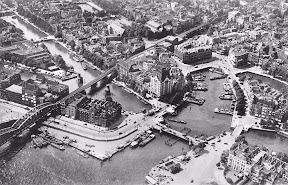
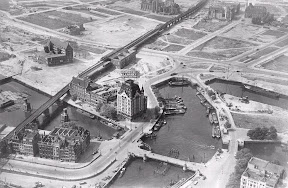
My street is about in the top left corner of the pictures... To the best of my knowledge, these pictures are the property of the educational organisation KMLA.
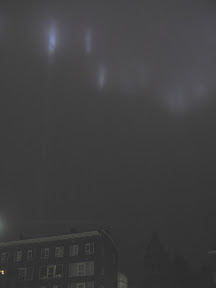
The picture below though is my own. It shows the lights produced by the hundreds of projectors that the city placed around the border of the destroyed area today. The Dutch call it the Vuurzeegrens (the border of the sea of fire). It speaks for itself, I guess.
Eventually, you can find a lot more information there: Gemeentearchief.
Today was 14th May and a very special day in Rotterdam. It was Herdenkingdag, the commemoration of the day when, 67 years ago, the historical town center was totally wiped out by 95 Henkel 111 from the Luftwaffe. The old city (which was at that time looking very much like Den Haag) burned completely, leaving 73,000 homeless and 850 killed.
To give you an idea and commemorate this horrible day in my own way, I have uploaded two pictures which speak for themselves. They show the exact area where I know live, before and after the bombing.
My street is about in the top left corner of the pictures... To the best of my knowledge, these pictures are the property of the educational organisation KMLA.
The picture below though is my own. It shows the lights produced by the hundreds of projectors that the city placed around the border of the destroyed area today. The Dutch call it the Vuurzeegrens (the border of the sea of fire). It speaks for itself, I guess.
Eventually, you can find a lot more information there: Gemeentearchief.
Subscribe to:
Posts (Atom)